Dri-Eaz Water Damage Restoration in Corona: A Homeowner’s Guide
A standard big-box dehumidifier pulls roughly 30 pints of moisture from the air each day. A Dri-Eaz LGR 7000XLi pulls up to 130. That gap is the difference between a three-day dry and a seven-day dry, and since insurance coverage, temporary housing costs, and the risk of secondary mold all tick upward with time, the equipment a restoration contractor rolls into your Corona home matters more than most people realize. If you’re facing water damage right now and would rather not sort through equipment specs, call (833) 589-7005 for a free estimate.
Why Dri-Eaz Shows Up in Serious Restoration Work
Dri-Eaz has been building drying equipment for the restoration industry since 1980. Their units are not upgraded versions of what you’d find at Home Depot. They’re engineered for a different job entirely: pulling water out of saturated building materials, not just making a damp room feel less humid.
The key difference comes down to LGR technology. LGR stands for Low Grain Refrigerant. A conventional dehumidifier passes air over cold coils, condensing moisture. It works fine in muggy conditions but loses efficiency as the air dries out. LGR units use a refrigerant engineered to keep pulling water even when the air is already dry. Here in Southern California, where ambient humidity is often low, that’s a bigger advantage than homeowners expect. A conventional unit may technically run in Corona’s dry air and collect very little, while an LGR unit keeps extracting water from hardwood, drywall, and framing because the material itself stays wet long after the room feels dry to the touch.
This is why the restoration industry adopted LGR as the default standard years ago. The IICRC’s S500 water damage restoration reference guide, the document that trained technicians follow, assumes LGR-class equipment in its drying chamber calculations. When a contractor in Corona shows up with consumer-grade dehumidifiers, they’re not following the industry standard that insurers and adjusters recognize.
How to Identify Dri-Eaz Equipment On-Site
If you’ve already called a restoration company and they’ve set up equipment in your Corona home, you can verify what’s actually running without being confrontational about it.
Dri-Eaz units are branded clearly. The dehumidifiers are typically white or gray with black and red lettering. Model names like the LGR 7000XLi, Revolution LGR, or DriTec are printed on the side panel near the controls. Air movers from Dri-Eaz, such as the Rover or Ace, are compact plastic units usually in red, black, or gray. They don’t look like oscillating household fans.
Off-brand or contractor-branded equipment isn’t automatically a problem. Some restoration firms use their own branding on quality units, and several reputable manufacturers compete with Dri-Eaz. Phoenix, XPOWER, and B-Air also make commercial-grade LGR dehumidifiers. The real question is the spec sheet, not the label. Ask for the unit’s AHAM rating in pints per day at AHAM conditions (80°F and 60% relative humidity). A genuine LGR will show 70 pints or more. Anything rated below 50 pints at AHAM conditions is basically a residential unit wearing a work jacket.
We’ve seen Corona homeowners authorize work without knowing what equipment would arrive. That’s a mistake. The equipment manifest should be part of the written scope you sign.
What Equipment Grade Actually Does to Your Claim
Insurance adjusters think in terms of drying days. Every additional day means more equipment rental hours, more visits, more monitoring, and higher total indemnity. A three-day dry with commercial LGR equipment costs less than a seven-day dry with underpowered units, even though the daily rate on the commercial gear looks higher on paper.
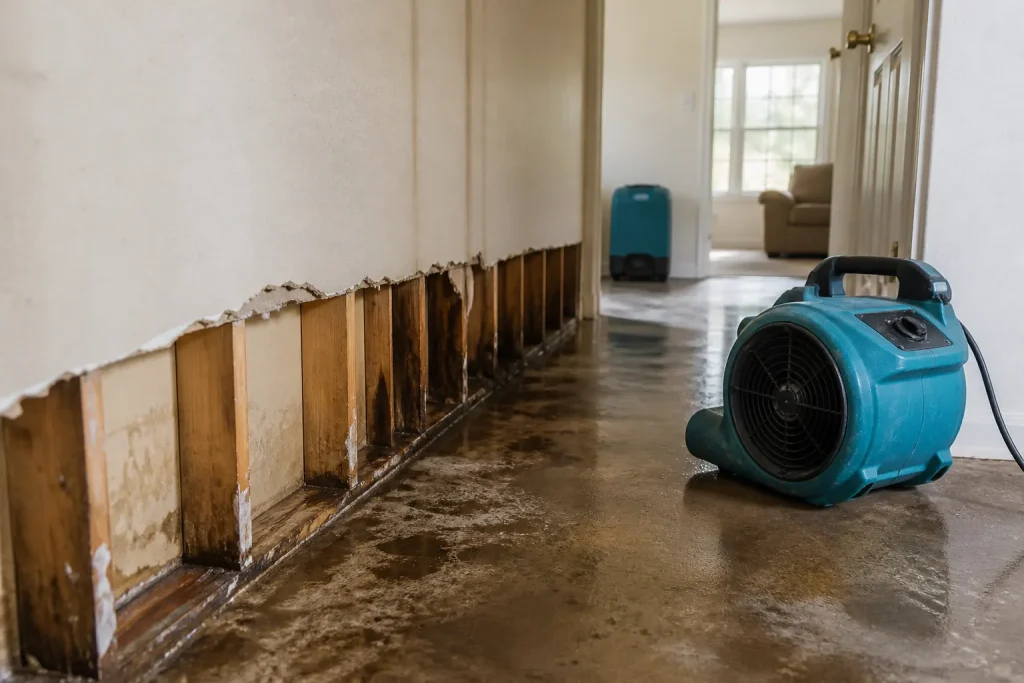
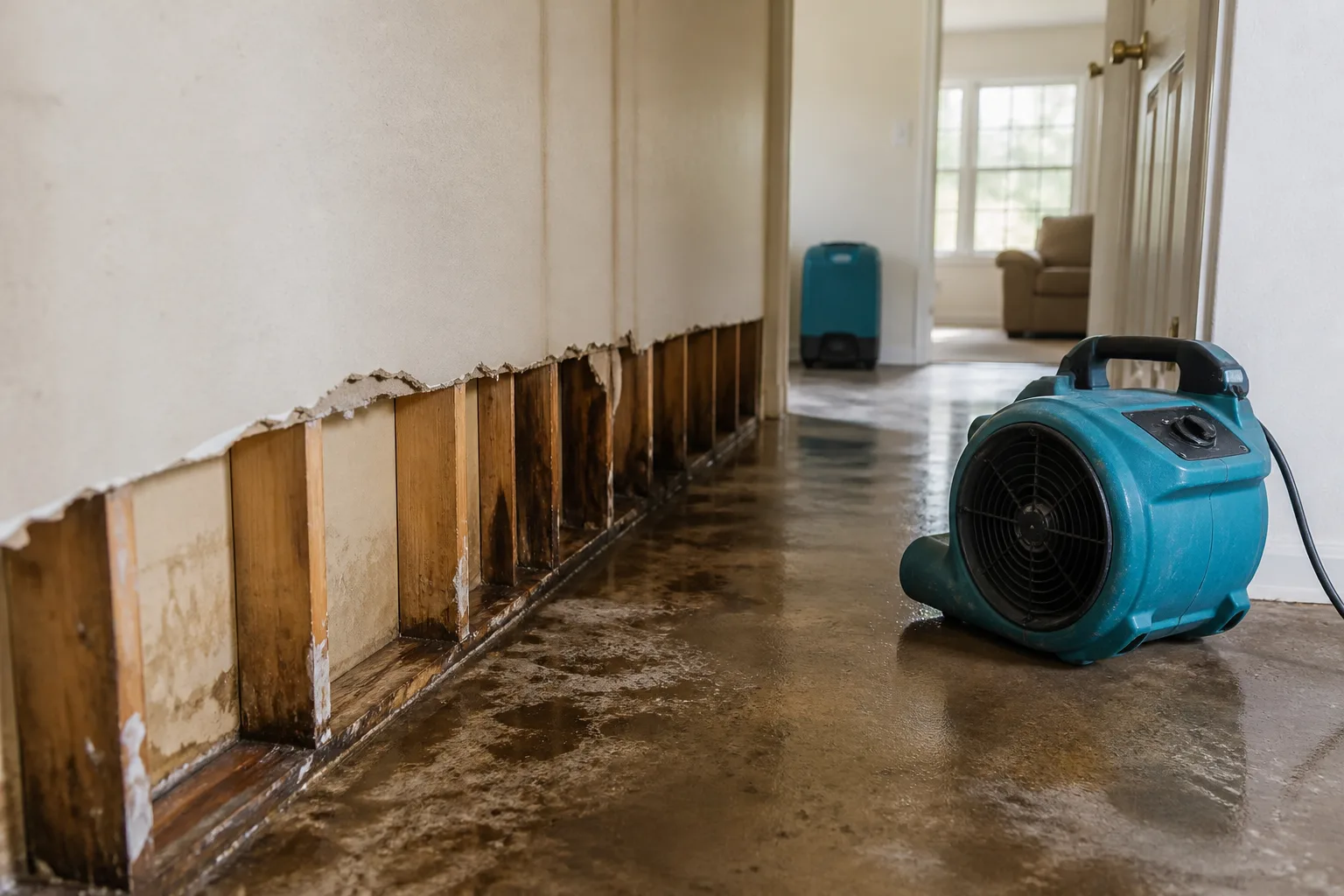
Let’s look at the numbers in a typical Corona single-story home with a slab leak that soaked 400 square feet of flooring and wicked up into the drywall. With Dri-Eaz or equivalent LGR dehumidifiers and proper air movement, that structure can often reach dry standard, verified with moisture meters, in three to four days. The same job with consumer-grade dehumidifiers might take eight to ten days, assuming it ever fully dries. Meanwhile, wet drywall left behind baseboards is beginning to support microbial growth within 24 to 48 hours. That’s how a manageable water loss becomes a mold remediation project, which doubles or triples the total scope.
This is also why our team at OC Restoration Co home runs Dri-Eaz, Phoenix, and Injectidry equipment. Not because the brand name impresses anyone, but because drying speed is the single biggest factor in keeping a water damage claim small. An adjuster who sees documented drying curves from properly rated equipment faces a much cleaner file than one who sees a contractor still futzing with rental units on day nine.
Questions to Ask a Corona Restoration Contractor Before Signing
The authorization form you sign locks you into a scope of work. Before you sign, ask these five questions. A serious contractor in Corona will answer all of them without hesitation.
- What dehumidifiers will you actually place in my home, and what are their AHAM pint ratings? You want LGR units rated 70 pints or higher. If they can’t name the model, walk away.
- How many air movers per affected room? The IICRC standard assumes roughly one air mover per 10 to 15 linear feet of affected wall, plus additional units for floor coverage. A contractor that shows up with two fans for a flooded living room is under-tooled.
- Do you use moisture meters and document daily readings? Drying without meters is guesswork. Daily readings with written logs are what insurance adjusters expect.
- Do you use Injectidry or similar systems for inside-wall drying? If water got inside wall cavities, opening every wall is demolition-heavy and expensive. Targeted injection drying systems can dry the cavity through small access points, preserving more of your original structure. We run Injectidry in Corona specifically for this. It cuts reconstruction scope, which cuts total claim cost.
- Will you provide a written scope with equipment manifest before work starts? If the answer is no, or if the answer is “we’ll figure it out on site,” keep looking. A written scope protects you from scope creep and gives your adjuster something concrete to review.
Data Logging and the Paper Trail That Protects You
Modern Dri-Eaz LGR units have a feature most homeowners never hear about: they record environmental conditions. Temperature, relative humidity, and sometimes grains per pound of air are logged continuously. A technician can download that data onto a USB drive and produce a graph showing exactly when each area of the house reached dry standard.
This matters for two reasons in Corona. First, it’s the documentation your insurer wants. A drying log with real data points is far harder to dispute than a technician’s handwritten notes. Second, it protects you if there’s a dispute about whether the house was actually dry before reconstruction began. If a general contractor later claims they were told the slab was dry and it wasn’t, the data log settles it.
We include photo documentation and data logs with every water loss we handle. It’s standard practice in our Water Damage Restoration in Fallbrook work and it’s standard in Corona too. The adjuster gets a complete file, the homeowner gets a clear picture, and nobody has to argue about what happened on day four.
One of our techs pulled an LGR 7000XLi out of a garage over in the Dos Lagos area a few years back where the homeowner’s son had tried to dry the place with two box fans and a borrowed household dehumidifier. By the time we got there, the drywall was reading 40% moisture content and the baseboards were starting to smell. The homeowner’s first question was whether the fans helped. The answer was: they helped move air around, but they moved air around wet drywall for five days while the problem got worse. That’s not a knock on the homeowner. Most people don’t know that air movement alone can accelerate evaporation into areas that were previously dry, spreading the damage footprint. It’s a good example of why trained judgment matters as much as the machine.
When to Call a Pro
If you’re reading this and water is still standing in your home, or if you can see water staining that’s more than 24 hours old, don’t wait. The drying window is short. Here’s the honest short list of situations where you want a certified team on-site rather than a DIY attempt:
- Water touched drywall or insulation. You cannot dry a wall cavity with a fan in the room. It needs either targeted cavities in the wall or professional cavity drying.
- Water sat for more than 48 hours. Microbial growth becomes likely. You may need both water damage restoration and Mold Remediation in Fallbrook style protocols, and in Corona the process is the same.
- Water came from a sewage source or exterior flood. This is category 2 or category 3 water and it requires sanitization, not just drying.
- You’re filing an insurance claim. Your adjuster will want documented, professional drying. The equipment and data logging alone are worth bringing in a certified contractor.
The related service note for Corona homeowners: if the water event was bad enough to trigger a fire, such as from a shorted water heater, we handle Fire Damage Restoration in Fallbrook and the same protocols apply in Corona. One team, one scope, one adjuster conversation.
The Bottom Line
The drying equipment in your Corona home during a water damage event isn’t a cosmetic detail. It determines how long you’re displaced, how much demolition your walls endure, how high the final claim lands, and whether you have mold problems six weeks from now. Dri-Eaz units earn their place on serious restoration trucks because they dry structures faster and leave a data trail that insurance adjusters respect. That’s not brand loyalty; it’s arithmetic.
If you’re in Corona and need help assessing damage or getting a restoration scope in writing before you sign anything, OC Restoration Co offers free estimates. Call (833) 589-7005. We’ll tell you honestly what you’re looking at, what equipment it’ll take, and what your options are for surgical drying.
Frequently Asked Questions
What is LGR technology and why does it matter in Corona’s climate?
LGR stands for Low Grain Refrigerant. It’s a dehumidifier design that keeps extracting water from the air even when relative humidity drops below 40%, which is common in Corona’s already-dry inland climate. Conventional dehumidifiers lose efficiency as air dries out, so they struggle to pull moisture from saturated building materials even when the room feels dry. LGR units keep pulling water from drywall, hardwood, and framing until those materials genuinely reach dry standard.
How do I know if a restoration contractor is using professional-grade equipment?
Ask for the dehumidifier’s AHAM rating in pints per day. Professional LGR units are rated 70 pints or higher at AHAM conditions. If a contractor can’t tell you the model and rating of the dehumidifiers they’ll place in your home before you sign an authorization, that’s a red flag. Serious restoration firms also document daily moisture readings with meters, not just time on the clock.
Can I dry water damage myself with fans and a household dehumidifier?
For small, contained spills like a water heater leak caught within an hour, and when water never touched drywall or flooring seams, possible. For anything involving drywall, insulation, cabinetry, or water sitting longer than 24 hours, no. Household dehumidifiers are rated for comfort, not structural drying. They lack the pint-per-day capacity and the data logging that restoration-grade units provide. Attempting it usually extends the drying time and increases the chance of secondary mold.
Will my insurance company accept Dri-Eaz equipment and data logs?
Yes. Dri-Eaz and similar commercial LGR equipment produces drying data that adjusters recognize because it aligns with the IICRC S500 standard they reference. The data logging capability shows when each area reached dry standard, which supports the claim and protects against disputes. Ask your restoration contractor to include the drying log with the claim file. If you need help in Corona with a water loss or a drying plan your adjuster will sign off on, call (833) 589-7005 for a free estimate.
Written by the team at OC Restoration Co, serving Corona since 2017.
Need Damage Restoration Help?
Call OC Restoration Co — licensed & insured, here with fast after-hours help in Corona.
(833) 589-7005