
Last updated October 31, 2026
 Water damage drying
 Fire & smoke cleanup
 Mold remediation
 Storm response
 Sewage cleanup
 Reconstruction
Free visual inspection and a written scope of work before any mitigation begins - photos, moisture readings, and drying logs go in your claim file
The scope we write is the scope we bill. Anything new gets shown to you, in writing, before we touch it.
Get your free estimateThe Complete Guide to Damage Restoration in Corona
Most Corona homeowners treat damage restoration as a single event to get through. The insurance claim gets filed, a contractor shows up, walls get torn out, things get rebuilt. But here’s what almost nobody tells you: the decisions made in the first 72 hours determine whether that claim closes cleanly in six weeks or drags into a months-long dispute with your insurer. The average insurance claim supplement, filed because restoration work wasn’t documented correctly from day one, adds 47 days to a Corona homeowner’s displacement. This guide maps the entire restoration process as a sequenced protocol, not a checklist of phone calls, so you know exactly what should happen, in what order, and what documentation protects you at every step. For deeper reading, see our Complete Water Damage Restoration Guide for Corona Homeowners.
Quick Answer
Damage restoration in Corona is a three-phase protocol: mitigation (stopping active damage within hours), remediation (removing contaminated materials and treating affected structures within days), and reconstruction (rebuilding removed materials only after drying and clearance are documented). The sequence matters more than speed alone. A IICRC-certified restoration company following documented drying protocols and maintaining a verifiable drying log is the single strongest asset you can have in an insurance claim.
Restoration work we handle
Table of Contents
- The 72-Hour Documentation Window: What Insurers Actually Require
- How Corona’s Inland Heat Accelerates Secondary Damage
- Mitigation vs. Remediation vs. Reconstruction: Why the Distinction Matters
- What an IICRC-Certified Technician Does Differently on Day One
- How to Read a Restoration Drying Log (And Why It’s Your Claim’s Most Important Document)
- Water, Mold, and Fire: The Full Damage Cascade Under One Roof
- Common Mistakes to Avoid
- When to Call a Professional
- Frequently Asked Questions
The 72-Hour Documentation Window: What Insurers Actually Require
Insurance adjusters in California work from a specific set of documentation requirements when evaluating water, mold, and fire claims. The first 72 hours are when that documentation is created, and gaps created during this window are nearly impossible to reconstruct later. If you file a claim and the restoration company didn’t produce a proper drying log, didn’t document initial moisture readings, or didn’t photograph every affected surface before touching anything, you’re already facing a supplement request.
Here’s what a properly documented claim file includes from day one:
- Pre-mitigation photos: Every affected room, every affected surface, every item of contents before anything is moved or removed. Insurers require this to establish scope.
- Initial moisture readings: Documented readings from affected materials using professional moisture meters, recorded room by room. These readings establish that water damage actually occurred and where it traveled.
- Source identification: The exact cause (supply line failure, roof leak, appliance malfunction, sewage backup) documented in writing with photos of the source itself.
- Category and class determination: Water damage is categorized (Category 1, 2, or 3 based on contamination level) and classed (Class 1 through 4 based on absorption and evaporation load). This determination drives the entire scope of work.
- Daily drying log entries: Every 24 hours, updated moisture readings, drying chamber conditions (temperature, humidity, grain depression), and equipment placement changes.
- Contents inventory: A room-by-room list of affected contents with condition notes and photos, required before any contents are packed out or disposed of.
In our experience in Corona, the majority of claim disputes we get called into involve missing documentation from the first day, not disagreements about what happened later. A homeowner who can hand their adjuster a complete, dated document trail from hour one rarely fights about scope. The discussion shifts to cost, which is a much more straightforward conversation.
The takeaway: whoever you call first, ask them directly how they document their work for insurance purposes. If they can’t describe their drying log protocol in detail, keep looking.
How Corona’s Inland Heat Accelerates Secondary Damage
Corona sits in the Inland Empire’s thermal belt, where summer temperatures routinely exceed 95°F and indoor relative humidity can spike after water intrusion events, even on days the outside air feels dry. This inland climate pattern creates a compressed timeline for secondary damage that homeowners in coastal cities like Newport Beach or Long Beach simply don’t face.
Here’s what happens in Corona specifically:
- Mold colonization accelerates: Mold spores need moisture and warmth to colonize. In Corona’s summer heat, colonization can begin in as little as 24 to 48 hours after water intrusion, compared to 72 hours or longer in cooler coastal climates. By the time a Corona homeowner sees visible mold, the colony is usually well established behind the wall cavity.
- Wood warping and cupping compounds: Hardwood floors and structural framing dry unevenly in high heat, leading to cupping, crowning, and permanent warping if not dried under controlled conditions. Natural air drying in Corona’s heat dries surfaces too fast while leaving subfloor and cavity moisture trapped, which creates precisely the conditions for warping.
- Evaporation rates outpace extraction capacity: The dry heat pulls moisture out of materials quickly, but if the water isn’t extracted and the drying environment isn’t controlled with professional equipment, the moisture moves deeper into structural cavities where it causes hidden damage. This is why professional extraction followed by controlled structural drying matters more in Corona than in milder climates.
- HVAC systems compound the spread: Corona homes run air conditioning heavily during the months most damage events occur, and running an HVAC system with wet building materials in the envelope circulates moisture and particulates through ductwork, expanding the affected area beyond the original intrusion zone.
The protocol implication is straightforward: in Corona, the window for effective mitigation is shorter than in coastal Southern California. If water intrusion happens, the first 24 hours matter more here than in cities where the climate gives you a longer runway. This isn’t alarmism, it’s physics.
Our water damage restoration team in Fallbrook sees the same pattern in inland valley climates across Riverside and San Diego counties. Heat compresses timelines, and timelines compressed without documentation create claim problems.
Mitigation vs. Remediation vs. Reconstruction: Why the Distinction Matters
The single most common scope-of-work dispute in California restoration claims happens when homeowners, contractors, and insurers use these three terms interchangeably. They are not the same thing, and conflating them causes adjusters to deny line items, contractors to underbid, and homeowners to end up with partial restorations that fail later.
Here’s the distinction, clearly:
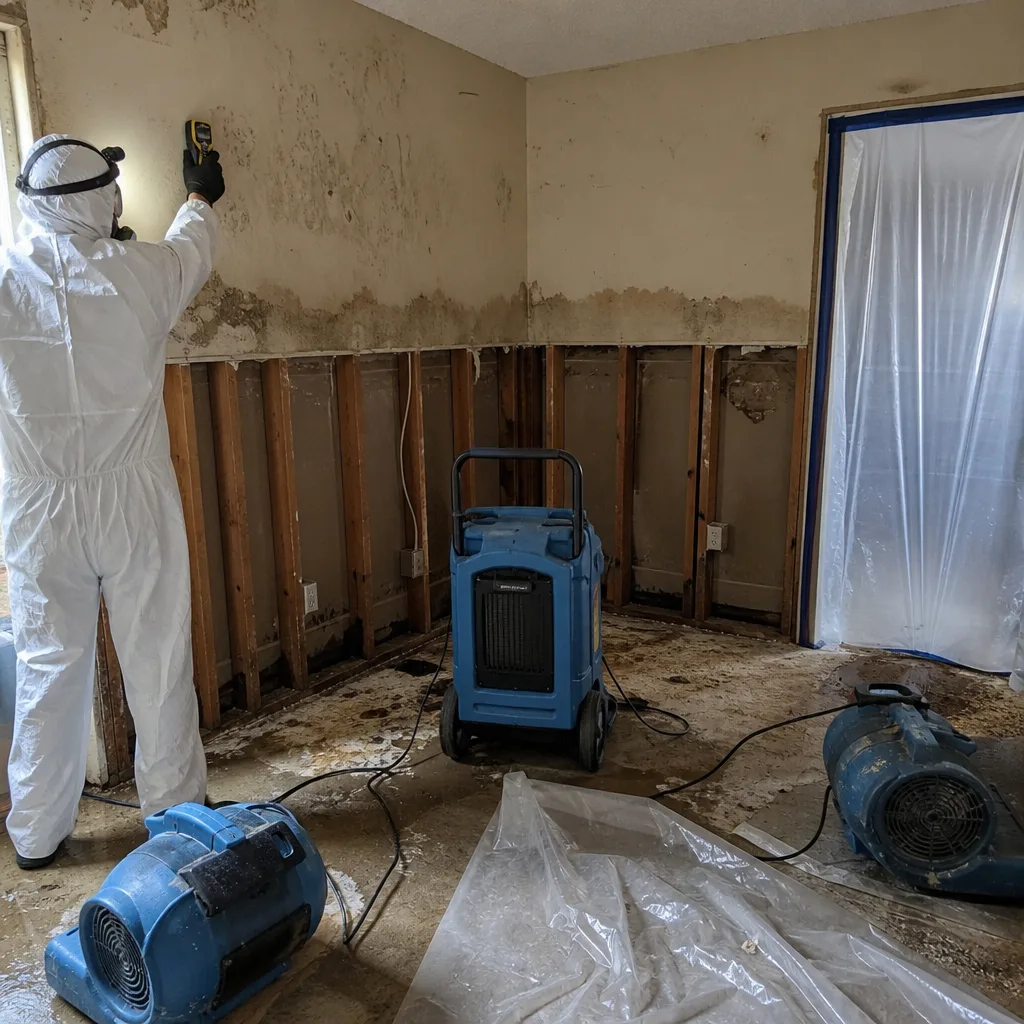
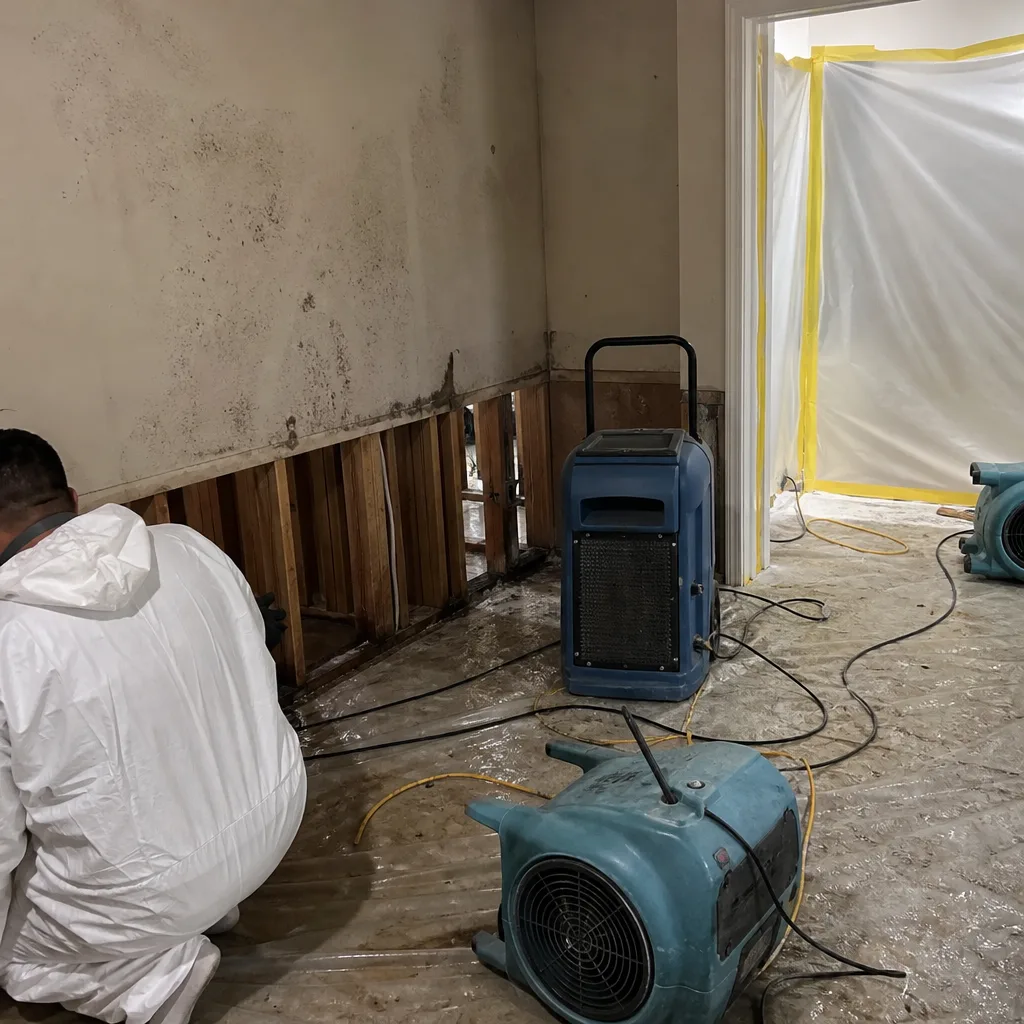
- Mitigation is stopping active damage. Water extraction, removing wet drywall and insulation, setting up drying equipment, boarding up broken windows, tarping damaged roofs. Mitigation is what happens in the first hours and days. It prevents the damage from spreading. It does not fix anything.
- Remediation is removing and treating contamination. For mold, this means containment, HEPA filtration, physical removal of affected materials, and treatment of remaining surfaces with antimicrobial agents. For fire, this means soot and smoke residue removal, odor neutralization, and cleaning or disposing of affected contents. Remediation addresses what contamination has already done.
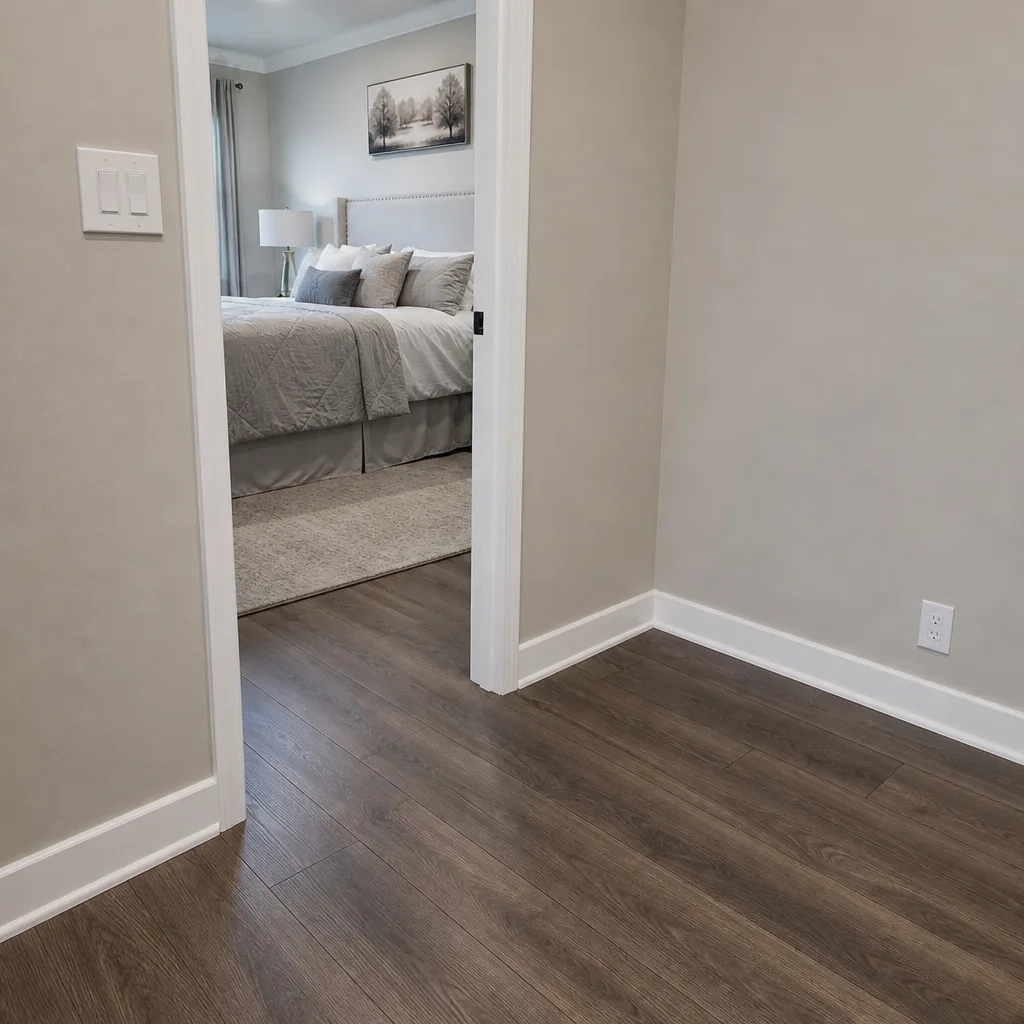
- Reconstruction is rebuilding what was removed. Drywall, flooring, trim, paint, cabinetry, fixtures. Reconstruction returns the property to its pre-loss condition. It happens only after mitigation is complete and remediation clearance has been documented.
Why does this matter to a Corona homeowner? Because insurance policies often treat these phases differently. Mitigation is typically covered under emergency services. Remediation may require separate approval or have limits. Reconstruction is usually applied to the rebuild portion of your policy. If your contractor writes a single scope item that says “restore kitchen after water damage” without separating mitigation from remediation from reconstruction, you’re asking your adjuster to figure out what belongs where, and adjusters don’t guess, they request clarification, which delays your claim.
The protocol: insist that any restoration company you work with in Corona provide a written scope of work that clearly separates the three phases, with line items for each. This document is the foundation of your claim file, and it should read like a protocol, not a summary.
What an IICRC-Certified Technician Does Differently on Day One
The Institute of Inspection, Cleaning and Restoration Certification (IICRC) is the restoration industry’s gold-standard credentialing body. It sets the standards, called S500 for water damage and S520 for mold remediation, that define what a properly performed restoration actually looks like. General contractors, on the other hand, are licensed to build. They are not trained in the science of drying, contamination control, or psychrometrics.
Here’s what a IICRC-certified technician does differently in the first 24 hours:
- Identifies water category and class before touching anything: A certified technician samples and assesses the water source to determine contamination level, then calculates the class of water loss based on affected square footage, material absorption, and evaporation potential. This drives equipment selection and drying chamber design. A general contractor typically starts pulling materials and figures out the rest later.
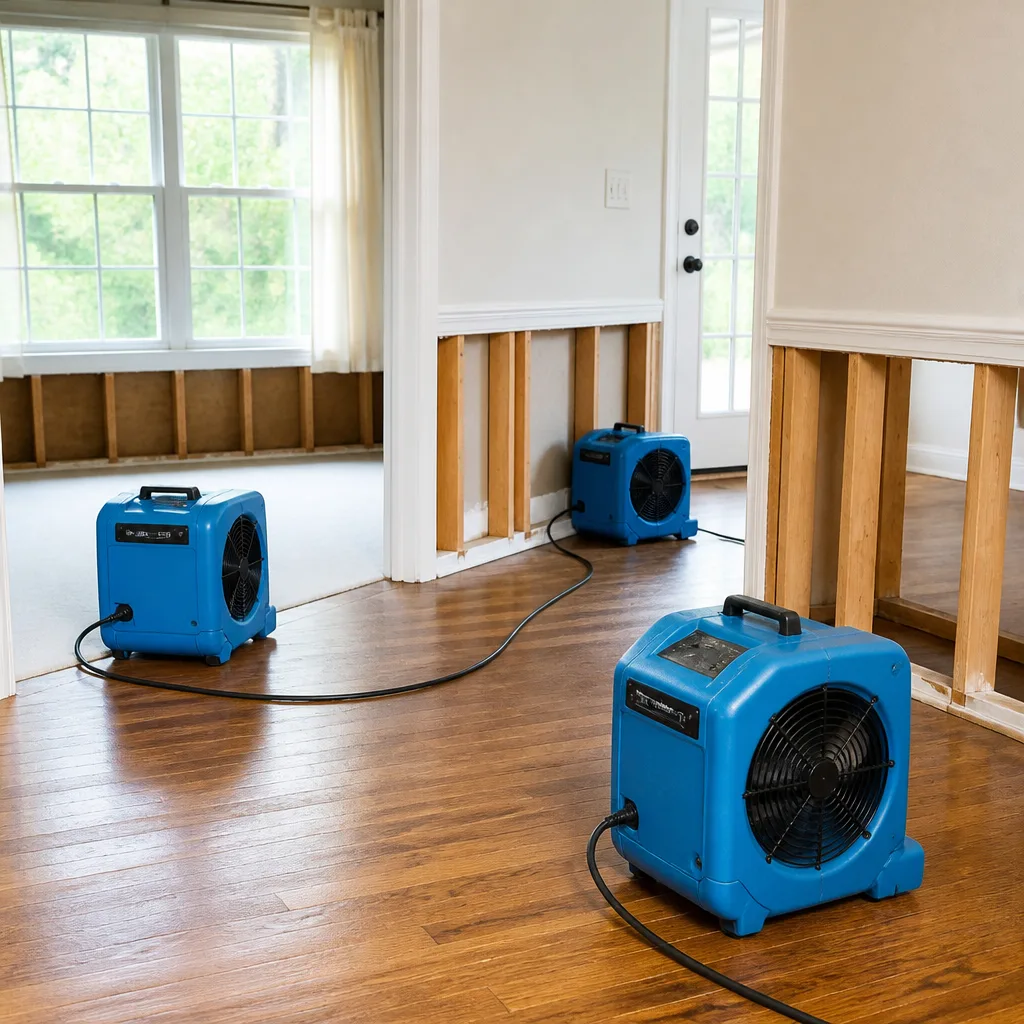
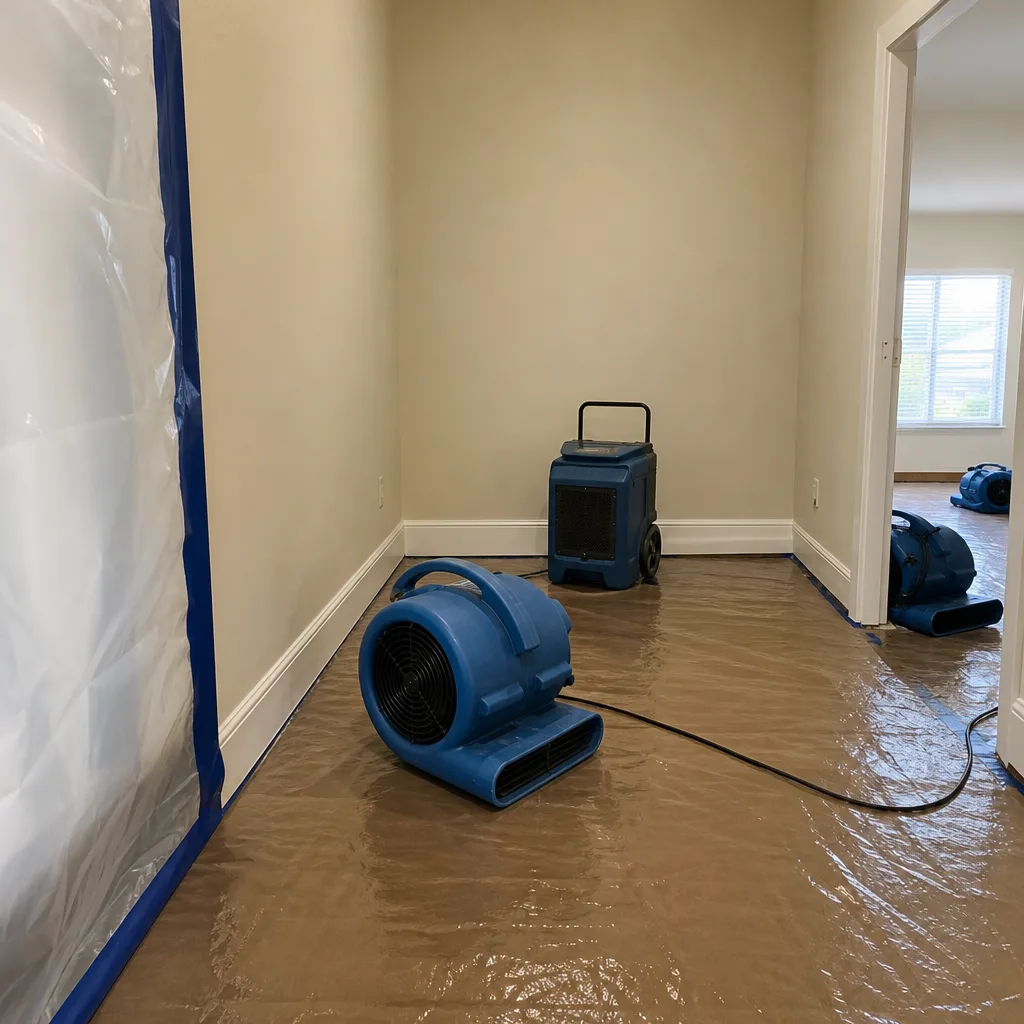
- Builds a containment and drying chamber: Professional restoration involves creating controlled drying environments with airmovers, dehumidifiers, and temperature management calculated for the specific class of loss. This is not running fans. It’s psychrometric engineering, and it requires equipment like Dri-Eaz dehumidifiers and Phoenix airmovers, not rental equipment from a home improvement store.
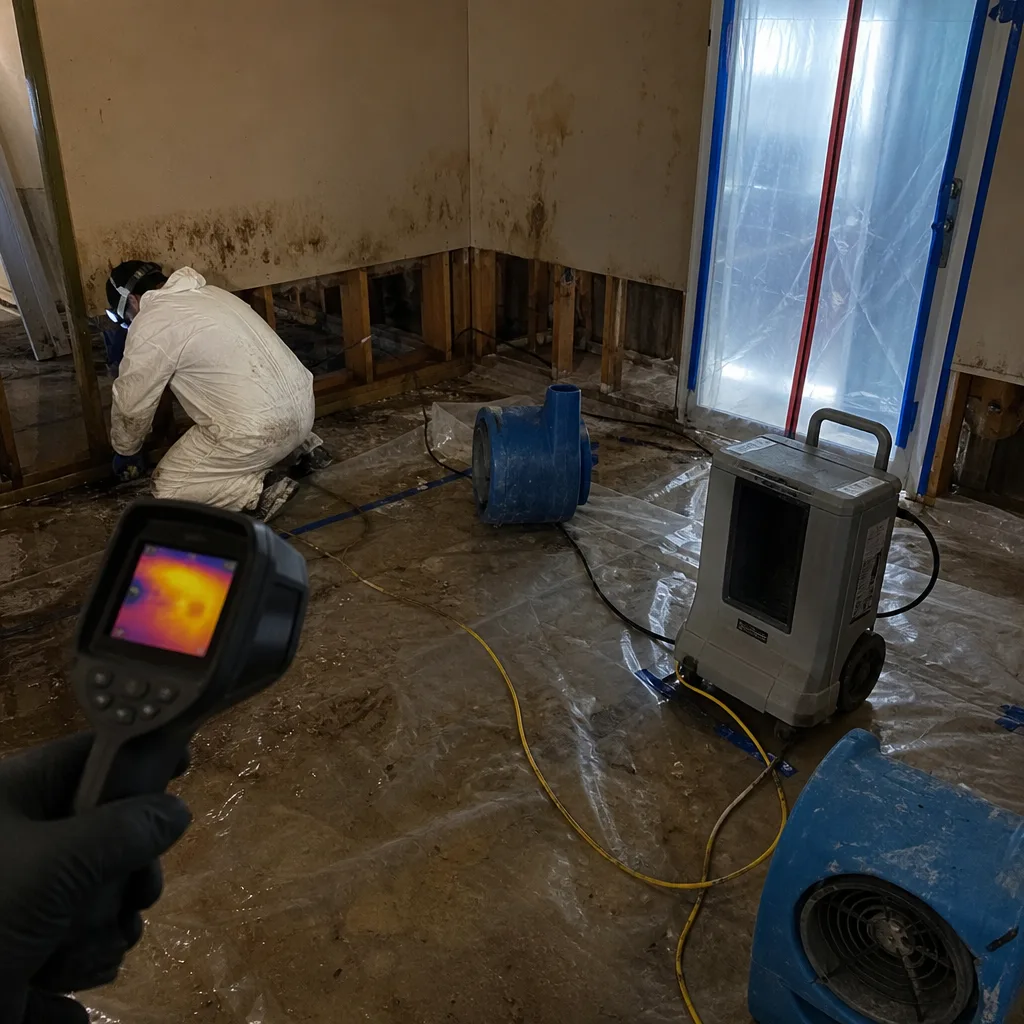
- Documents everything with moisture meters and thermal imaging: Certified technicians take baseline readings, establish drying goals, and document progress against those goals daily. This drying log is what insurers require, and it’s the difference between a claim that closes and one that gets supplemented for missing documentation.
- Understands structural drying, not just surface drying: Water travels through materials, not just across them. A certified technician uses tools like Injectidry systems to extract moisture from wall cavities and under cabinets without unnecessary demolition. A general contractor’s primary tool for a wet wall cavity is a Sawzall.
- Follows an established standard of care: IICRC standards are documented, published, and defensible. If a claim dispute arises, the question becomes “did the work meet S500 or S520 standards?” A certified technician can point to the standard and the documentation. A general contractor is left arguing that their approach was “standard practice,” which doesn’t hold up in claims review.
This isn’t about credential snobbery. It’s about the fact that restoration is a specialized discipline with its own science, and the people who do it best are trained and certified to a documented standard, not improvising based on construction experience. In our experience as an IICRC-certified company serving Corona, we’ve walked into homes where a general contractor “dried” a kitchen for two weeks, stripped the drywall, and told the homeowner it was ready for rebuild. The moisture readings in the wall cavities told a different story. That homeowner’s rebuild failed within a year, and the insurance claim had already closed.
How to Read a Restoration Drying Log (And Why It’s Your Claim’s Most Important Document)
The drying log is the document your adjuster will actually review when evaluating your restoration claim. It’s also the document most homeowners never see. If you understand what it should contain, you can tell within sixty seconds whether your restoration company is doing serious work or just moving air around.
A proper drying log contains these data points, updated every 24 hours:
- Moisture readings per affected material: Wood, drywall, concrete, and other materials are measured with moisture meters, and readings are recorded as either moisture content percentage (for wood) or relative scale readings (for other materials). The log should show readings declining daily toward a documented dry standard.
- Drying chamber conditions: Temperature and relative humidity inside the affected area, recorded daily. The restoration company is managing these numbers to create optimal evaporation conditions.
- Grain depression: The difference between the water vapor pressure in the air and in the wet material. It’s the mathematical measure of how hard the drying environment is pulling moisture out of materials. Professional restoration companies track this number. If your “drying log” doesn’t include it, you’re not looking at a professional drying log.
- Equipment placement and settings: Where airmovers are positioned, which direction they’re pointing, how many dehumidifiers are running, and their settings. This should change over time as drying progresses.
- Daily progress notes: Brief notes on what was checked, what changed, and what the plan is for the next 24 hours.
Here’s why this matters so much: every day of drying costs money. Equipment rental, electricity, technician visits. If an insurer sees a drying log that shows moisture readings declining steadily and equipment being removed as drying goals are met, they approve the claim without question. If they see a log with missing days, flat readings, or equipment that never changed position, they start asking questions, and every question adds days to your displacement.
You don’t need to understand psychrometrics to read a drying log. You just need to see that readings are being taken, recorded, and showing progress. If your restoration company can’t produce a drying log when you ask, you have the wrong company in your house, and you should correct that in Corona before the documentation window closes.
Water, Mold, and Fire: The Full Damage Cascade Under One Roof
Most restoration companies specialize in one thing. Water mitigation companies don’t do mold remediation. Mold companies don’t do fire damage. Fire restoration companies don’t do water. But real-world damage events in Corona don’t respect those boundaries.
Consider the most common sequence: a supply line bursts on the second floor of a Corona home while the family is at work. Water runs for six hours before anyone notices. The water soaks through the floor assembly, saturates the ceiling below, runs down inside wall cavities, and pools in the first-floor subfloor. Water mitigation begins immediately. But here’s the cascade: within 48 to 72 hours in Corona’s inland heat, mold colonization begins in the wall cavities. The water damage claim is now a mold claim as well. And if any electrical components got wet, the risk of fire damage from shorted wiring adds a third layer.
When three different companies handle three different phases, the homeowner becomes a project manager, coordinating schedules, sharing documentation between contractors, and hoping nothing falls through the cracks. The coordination gap is where claims break down and where timelines blow out.
This is why a single-source restoration partner matters. One company that handles water extraction and structural drying, mold remediation with containment and clearance testing, and fire and smoke restoration with odor neutralization means one point of accountability, one documentation system, one drying log, one insurance narrative. That narrative continuity is worth more than any individual line item savings.
At OC Restoration Co, we operate this way by design. Our IICRC-certified technicians carry the same moisture meters, the same thermal imaging cameras, and the same documentation protocols across all three service lines. When a water damage job develops a mold condition, we don’t hand you a referral. We adjust the protocol, update the containment, and keep moving. Same team, same standards, same log.
Common Mistakes to Avoid
- Calling a contractor before calling your insurer: Every insurance policy has a duty-to-mitigate clause and specific claim filing deadlines. If you start demolition before filing, you may void coverage for that work. Call your insurer first, then call a restoration company, and tell the restoration company to document everything for the claim file.
- Using consumer-grade drying equipment: Box fans and a rental dehumidifier from a hardware store in Corona will dry the surface but not the structure. Moisture trapped in wall cavities and subflooring will cause mold and structural damage for months after the surface looks dry. Professional-grade equipment from lines like Dri-Eaz and Phoenix is engineered for structural drying.
- Accepting a scope of work that doesn’t separate mitigation from remediation from reconstruction: A single line item that says “restore bathroom” is an invitation for claim dispute and scope creep. Demand a phased scope with separate line items for each phase.
- Ignoring the drying log: The drying log is the primary evidence in your claim file. If you don’t ask for it and review it, you’re leaving the most important part of your claim to chance. Ask to see it daily, even if you don’t fully understand the numbers.
- Choosing the cheapest estimate: Restoration is not a commodity. An underbid from a company without IICRC certification, without professional equipment, and without a documented protocol will cost you more in claim supplements, failed rebuilds, and extended displacement than the difference in estimates. In Corona’s climate, cutting corners on drying is a multi-thousand-dollar mistake.
- Running your HVAC during mitigation: Your air conditioner circulates air through your entire home, including the wet areas. Running it during water mitigation spreads moisture and particulates through ductwork and into rooms that were never affected. Have your restoration contractor seal the HVAC and address ductwork as part of the protocol.
- Waiting to see if mold appears: By the time you see visible mold in Corona, the colony behind the wall is well established. If water intrusion occurred and drying wasn’t completed within 72 hours under controlled conditions, assume mold spores are present and have the area tested or treated proactively. Waiting costs more and complicates the claim.
When to Call a Professional
Any water intrusion that affects more than a single room, any sewage backup, any fire or smoke event that leaves residue, and any visible mold growth larger than about ten square feet warrants a professional restoration company. The same applies if water has been present for more than 24 hours, if water traveled through flooring or wall cavities, or if any electrical components were exposed to water. In all of these scenarios, the risk of secondary damage in Corona’s climate is high, and the documentation requirements of your insurance claim demand professional handling from day one. OC Restoration Co offers free estimates in Corona. Call (833) 589-7005 and we’ll walk through what happened and what the protocol should look like from here.
Frequently Asked Questions
Damage restoration in Corona typically ranges from $1,500 to $4,500 for minor water mitigation to $15,000 to $75,000+ for significant water, mold, or fire restoration involving structural drying, containment, and reconstruction. Every job is different, which is why a written scope of work with phased line items matters more than any estimate number. Call (833) 589-7005 for a free, detailed estimate for your specific situation.
Professional restoration companies respond to water and fire emergencies same-day in most Corona neighborhoods, because the mitigation window in this climate is compressed by inland heat. To prepare before disaster strikes, review our Damage Restoration Emergency Preparedness Guide for Corona Homes. The key is to call as soon as the damage is discovered. Every hour of delay in Corona’s summer heat pushes the secondary damage timeline forward.
Most California homeowner policies cover sudden and accidental water damage, like burst supply lines or appliance failures, but exclude gradual leaks and flood damage (which requires separate flood insurance). The determining factors are cause and documentation. A properly documented claim from a IICRC-certified restoration company with daily drying logs stands a far better chance of full coverage than an undocumented claim. Work with a restoration company that understands insurance documentation, and ask your adjuster about your specific policy limits.
Mold remediation for a contained area (one to two rooms) typically takes three to five days in Corona, including containment setup, removal, treatment, and clearance testing. Larger jobs take longer. The remediation timeline depends on how far the colony has spread, but in Corona’s climate, early intervention within the first 72 hours significantly shortens the process.
If visible mold covers more than about ten square feet, or if mold is present inside wall cavities, behind baseboards, or under flooring, cleaning the surface is not enough. Mold colonies extend into the materials they’ve colonized, and surface cleaning leaves the root structure intact. A professional assessment with moisture readings and, where appropriate, air sampling determines whether remediation is required. In our experience in Corona, most visible mold situations in water-damaged structures require remediation, not just cleaning.
OC Restoration Co serves the entire Corona area, including Sierra del Oro, Corona Hills, Eagle Glen, Dos Lagos, South Corona, and homes throughout the 92879, 92880, 92881, 92882, and 92883 ZIP codes. Explore our more guides & resources for additional homeowner support. Corona’s varied terrain, from hillside communities to valley floor neighborhoods, means water damage patterns differ from house to house, and our IICRC-certified technicians account for those differences in every protocol.
The Bottom Line
Damage restoration in Corona is a protocol, not a phone call. The sequence matters: mitigation stops the bleeding, remediation removes the contamination, reconstruction rebuilds the structure. Documentation ties it all together, and in this inland climate, the first 72 hours determine whether your claim closes cleanly or drags into supplement requests and displacement extensions. Work with a restoration company that operates to documented IICRC standards, uses professional-grade equipment, and treats your drying log as the centerpiece of your claim file. That’s what protects you, your home, and your insurance relationship, whether you’re in Sierra del Oro, Dos Lagos, or anywhere else in Corona. If you’re facing a damage event right now, call (833) 589-7005 for a free estimate and a documented protocol from day one.
Written by the team at OC Restoration Co, serving Corona since 2017.
See the difference
 Before
 After
 Before
 After
 Before
 After