Water Damage Restoration What It Really Costs: What Corona Homeowners Pay in 2026
Most Corona homeowners see a water damage restoration invoice with 40 to 60 line items and sign it without realizing those codes mean something very specific. That “DEHU – LGR” line versus “DEHU – STD” line represents roughly a $60 per day difference per unit. Over a typical 5 to 7 day dry, that single line item distinction can swing your bill by $300 to $840. Here’s what actually drives water damage restoration costs in Corona in 2026, how Xactimate pricing works, and where homeowners leave money on the table. If you’d rather skip the deep dive and talk to someone directly, call (833) 589-7005 for a free estimate.
What Corona Homeowners Actually Pay: 2026 Water Damage Restoration Cost Ranges
Water damage restoration in Corona typically runs between $2,400 and $7,800 for a standard single-room event like a supply line break or water heater leak. A whole-house event involving multiple rooms, Category 3 water, or structural drying behind walls can push that number to $12,000 or more. These are 2026 ranges based on what we see in Corona’s housing stock, which skews toward 1980s and 1990s slab foundations with copper supply lines that are now hitting the end of their service life.
Here’s a line-item breakdown of the most common Xactimate pricing we see in the Corona market this year:
- Water extraction (per room, light saturation): $180 to $325
- Water extraction (per room, heavy saturation or carpet removal): $350 to $600
- LGR dehumidifier, daily rate: $95 to $145 per unit per day
- Standard dehumidifier, daily rate: $35 to $85 per unit per day
- Air mover, daily rate: $25 to $45 per unit per day
- Antimicrobial application (per 100 sq ft): $55 to $95
- Baseboard removal and reset: $3.50 to $6.00 per linear foot
- Drywall removal (per sheet): $65 to $95 including disposal
- Moisture mapping and daily monitoring: $150 to $300 initial, $75 to $125 per revisit
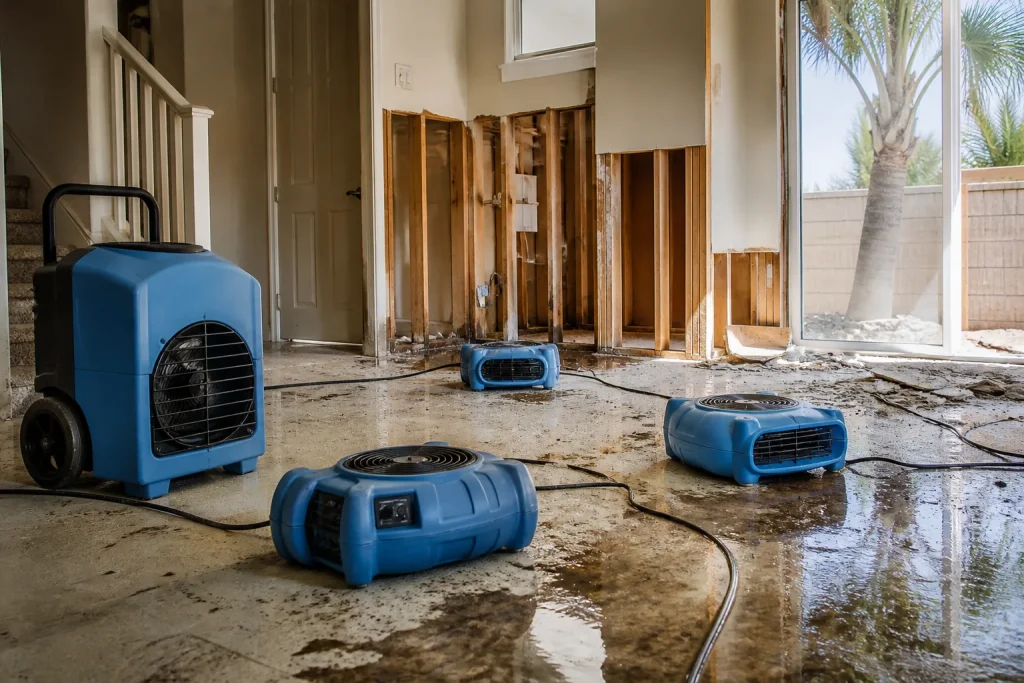
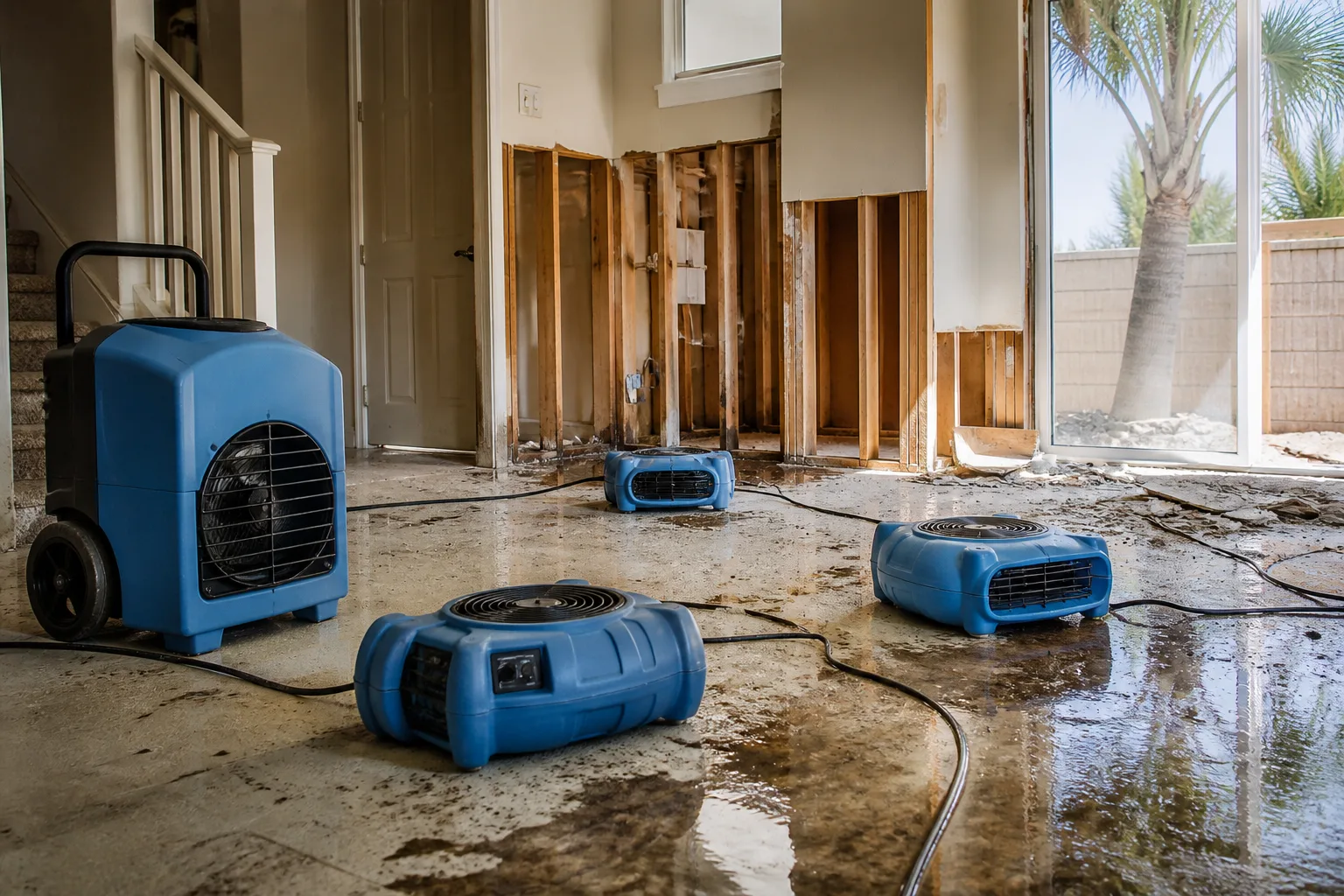
The dehumidifier distinction matters more than any other single line item. An LGR (low grain refrigerant) unit pulls moisture out of the air at a much higher rate than a standard refrigerant dehumidifier. In Corona’s summer heat, when indoor temperatures in a water-damaged room can sit at 85°F or higher, standard units lose efficiency dramatically. A legitimate restoration company uses LGR units for anything beyond a minor spill. A company padding an invoice might bill LGR rates while running standard units. We’ve walked into Corona homes where the previous contractor’s equipment tags showed standard dehumidifier models on an invoice charging LGR rates. That’s a $60 per day per unit difference, and with three units over seven days, that’s $1,260 in pure billing error.
If you’re dealing with a water event in Corona and want straight answers about what your invoice should look like, our team at OC Restoration Co home walks through every line item before work begins.
How Water Category Changes Your Total Cost Ceiling
Water damage is classified into three categories under the IICRC S500 standard, and that classification sets the ceiling on what a job can legitimately cost. This is where most Corona homeowners get surprised.
Category 1 (clean water): Supply line breaks, faucet overflows, water heater leaks. This is the cheapest category to restore. Carpet can often be dried in place with air movers and dehumidifiers. Total cost for a single room rarely exceeds $4,000. Typical drying time: 3 to 5 days.
Category 2 (gray water): Washing machine discharge, dishwasher overflow, sump pump failures. Contains some contaminants. Carpet pad almost always gets replaced. Hard surface flooring may need partial removal. Costs run 30% to 50% higher than Category 1 for the same square footage because of the added demolition and disposal. Corona sees a lot of this in the older track-home neighborhoods where second-story laundry rooms drain down through floor cavities into first-story ceilings.
Category 3 (black water): Sewage backups, river or flood water, any water that sat for 72+ hours. Everything porous gets removed: carpet, pad, baseboards, drywall up to the water line plus 12 to 18 inches above it. Requires full antimicrobial application and containment. Costs can run 3 to 4 times a Category 1 job for the same room. In Corona, sewer line backups happen most often in the older downtown corridor where clay pipes from the 1960s and 1970s are starting to collapse.
The category is determined by the source of the water, not by how dirty it looks. A crystal-clear puddle from a sewer backup is still Category 3. An IICRC-certified restoration firm has documented standards for each category, which matters when your insurer reviews the scope. Uncertified crews often treat everything as generic water damage, which either leaves contamination in place or drives unnecessary demo costs.
What California Homeowners Insurance Typically Covers in 2026
Most California homeowners policies cover water damage restoration when the damage is “sudden and accidental.” A burst supply line, a failed water heater, a broken washing machine hose, or an ice maker line that lets go all qualify. What usually doesn’t qualify: gradual leaks that have been going on for weeks or months, ground seepage, or flooding from exterior sources (that requires separate flood insurance).
Here’s the breakdown we help Corona homeowners navigate:
- Covered: Water extraction, demolition of damaged materials, structural drying, antimicrobial application, replacement of damaged drywall, baseboards, flooring, and paint
- Covered with limits: Mold remediation when it results from a covered water event (many policies cap this at $5,000 to $10,000 unless you carry a mold rider)
- Usually not covered: Repair of the source itself (the failed water heater, the leaking pipe fitting), unless the pipe burst was from a sudden pressure event
- Varies by policy: Contents restoration, temporary housing, and loss-of-use coverage
The deductible on a Corona policy typically runs $1,000 to $2,500. If your total restoration bill is $3,500 and your deductible is $2,500, filing the claim gets you $1,000 but puts a claim on your record. In our experience in Corona, it’s worth calling your agent once you have a real estimate in hand, not before the scope is understood.
Documentation is where homeowners leave the most money on the table. Take photos before anything gets moved. Photograph the moisture stains, the standing water depth, the affected baseboards, the water path from source to affected area. Insurance adjusters work from photos when they can’t be on site same day, and Corona adjuster availability in 2026 is still thinner than pre-pandemic levels.
If water damage has triggered mold growth in your Corona home, read our guide on Mold Remediation in Fallbrook to understand what happens when water damage advances past the drying phase.
Drying Time Is the Real Cost Lever
Here’s the thing most Corona homeowners never hear: equipment count is not what drives your invoice. Drying duration is. You can have six air movers and two dehumidifiers in a room, but if the drying takes ten days instead of five, your bill just doubled on the daily rate lines, which is where most of the cost sits.
Daily equipment rates add up fast:
- 2 LGR dehumidifiers × $120/day × 7 days = $1,680
- 2 LGR dehumidifiers × $120/day × 3 days = $720
That’s a $960 difference on dehumidifiers alone, before you touch air movers, monitors, or labor. The largest variable in drying time is not water volume. It’s how quickly the structure got dried after the water stopped, and whether the right equipment was used from day one.
Corona’s climate works in the homeowner’s favor during the dry season (April through November), when ambient humidity sits low and windows can be opened to accelerate drying. During winter inversions and Santa Ana wind reversals, indoor drying slows because exterior humidity rises. A restoration company that understands Corona’s microclimate patterns will adjust equipment and daily monitoring accordingly. One that treats every job the same will over-dry or under-dry, and you’ll pay for the inefficiency either way.
Here’s what you can do as the homeowner to keep drying on schedule:
- Ask for a daily moisture log. You should see numbers trending down on every affected surface and cavity. If they’re flat for two consecutive days, something is wrong with the drying setup.
- Ask which dehumidifier models are running. LGR units in a Category 1 room dry faster. If you see standard units on a big job, your drying timeline is inflated.
- Keep interior doors closed in the affected area. Open doors expand the drying cubic footage and slow everything down.
- Report any new water activity immediately. A secondary leak mid-dry resets the entire timeline.
Structural drying is where experience actually pays for itself. Our technicians use Injectidry systems to dry wall cavities and under flooring without pulling everything apart, which saves demolition cost and shortens the drying window. That’s the difference between a five-day dry and an eight-day dry with a bigger demo bill attached.
For water damage specifically in the Fallbrook area, see our service page on Water Damage Restoration in Fallbrook for details on our process.
Invoice Red Flags: Scope Padding vs. Legitimate Line Items
Most restoration contractors in Corona are honest. But the industry has a reputation problem because the invoice structure rewards aggressive scoping. Xactimate pricing is standardized, which means a contractor can’t inflate the per-unit price on a dehumidifier. What they can do is inflate the quantity: number of air movers, number of days, linear feet of baseboard, square feet of antimicrobial application, number of dehumidifiers.
Here are the red flags we tell Corona homeowners to look for:
- More air movers than square footage justifies. Rough guideline: one air mover per 50 to 65 square feet of affected flooring. Eight air movers in a 200-square-foot bedroom is padding.
- Dehumidifiers billed when none are on site. Walk the job. Look at the equipment. Write down model numbers. Compare to the invoice.
- Drying days billed after moisture logs show the room was already dry. If the daily moisture readings hit the dry standard on day four, but the invoice bills seven days of equipment, that’s scope padding.
- Antimicrobial application billed as full-surface when only a small area was treated. The invoice should specify square footage. Ask for it.
- Demolition charges for materials that were already scheduled for replacement. If carpet was being replaced anyway, charging full extraction and disposal line items without noting pre-existing condition is double-dipping.
- Daily monitoring billed on days nobody visited. Photo documentation and time-stamped moisture readings should back up every monitoring charge.
The goal of a well-run restoration job is to dry the structure to its pre-loss condition, document everything, and produce an invoice your insurer can verify against industry standards. Our process includes a written scope before work begins, photo documentation throughout, and a final walkthrough where every line item maps to work actually performed.
When to Call a Pro
You can handle a small clean-water puddle from an overflowing toilet tank (not bowl) with towels, fans, and open windows if you get to it within an hour and there’s no water penetration into walls or under flooring. Anything beyond that deserves a professional assessment. Water finds the lowest point in a structure fast, and in Corona’s slab-foundation homes, that means water travels under base plates, into wall cavities, and beneath flooring within hours. What looks like a 10-square-foot spill is often a 100-square-foot problem hiding under the surface.
If you’re weighing whether to file a claim, want a second opinion on an invoice, or need someone to take the whole thing off your plate, we’re OC Restoration Co home. We’re IICRC-certified, members of the Restoration Industry Association (RIA) and IFA, and we run commercial-grade Dri-Eaz, Phoenix, XPOWER, B-Air, and Injectidry equipment. We handle water damage restoration, mold remediation, and fire damage restoration in Corona and the surrounding communities under one roof, which means you’re not coordinating three different contractors when a water event turns into something bigger.
The Bottom Line
Water damage restoration in Corona runs $2,400 to $7,800 for most single-room events in 2026, with the final number driven by water category, drying duration, and whether the scope on your invoice matches reality. The dehumidifier line items are where most billing errors hide. Drying time, not equipment count, is the biggest cost lever. And your homeowner’s insurance likely covers the restoration, but not the repair of the failed source. If you’re in Corona and need help, OC Restoration Co offers free estimates. Call (833) 589-7005 and we’ll walk your job, document what we find, and put a written scope in front of you before any equipment lands in your living room.
Frequently Asked Questions
Most single-room water damage restoration jobs in Corona run between $2,400 and $7,800, depending on water category and drying duration. Whole-house Category 3 events can exceed $12,000. Your exact quote depends on square footage affected, water source, how long water sat before extraction, and how many daily drying days the structure requires.
Yes, if the damage was sudden and accidental from a covered source like a burst supply line, failed water heater, or broken washing machine hose. Gradual leaks, ground seepage, and exterior flooding are typically not covered. Most policies exclude repair of the source itself. Call your agent with a written estimate in hand before deciding whether to file.
Drying typically takes 3 to 7 days for clean-water events in Corona, with demolition and rebuild adding another 1 to 3 weeks depending on scope. Drying time in Corona is generally shorter during the dry season (April through November) and longer during winter inversion periods. Daily monitoring continues until moisture readings hit the structural dry standard.
If water has penetrated walls, flooring, or under base plates, or if the water sat for more than an hour, professional drying is cheaper than what you’ll pay later for mold remediation and structural repair. A small clean-water spill handled in under an hour with towels and fans can often be managed without professional help. Anything beyond that deserves an assessment from an IICRC-certified restoration firm. Call (833) 589-7005 for a free evaluation.
Written by the team at OC Restoration Co, serving Corona since 2017.
Need Damage Restoration Help?
Call OC Restoration Co — licensed & insured, here with fast after-hours help in Corona.
(833) 589-7005