Last updated October 31, 2026
 Water damage drying
 Fire & smoke cleanup
 Mold remediation
 Storm response
 Sewage cleanup
 Reconstruction
Free visual inspection and a written scope of work before any mitigation begins - photos, moisture readings, and drying logs go in your claim file
The scope we write is the scope we bill. Anything new gets shown to you, in writing, before we touch it.
Get your free estimateChoosing the Right Damage Restoration Brand: A Buyer’s Guide for Corona
Here’s something most Corona homeowners discover only after a pipe bursts at 2 a.m.: two restoration companies can show you identical credentials, matching IICRC certifications, and similar-looking websites, yet one will show up with a rented dehumidifier from a big-box store while the other arrives with a truck full of commercial Dri-Eaz drying systems. The difference doesn’t just affect the timeline. It affects whether your drywall gets saved or torn out, whether your claim gets documented properly for your adjuster, and how much you ultimately pay out of pocket. This guide will teach you how to evaluate what’s actually behind any restoration company’s brand, so you can make the decision before the emergency, not during it. For more guides & resources, see our blog. We’re writing this from Corona, where we’ve worked since 2017, and where summer heat turns minor water intrusion into mold problems faster than most homeowners expect.
Restoration work we handle
Quick Answer
The right damage restoration brand in Corona is one whose name is backed by verifiable IICRC certifications, owned commercial-grade drying equipment, local accountability, and documented insurance-claim experience, as detailed in The Complete Guide to Damage Restoration in Corona. Don’t choose based on national franchise recognition alone. Many independent certified firms in Corona offer stronger equipment inventories and more direct accountability than franchise locations, because the quality of your restoration depends on the actual crew and equipment that shows up, not the logo on their shirts.
Table of Contents
- Franchise vs. Independent: What a Big Name Actually Guarantees
- How to Audit a Restoration Company’s Equipment Inventory
- The Certification Ladder: IICRC, RIA, and What Those Letters Require
- Insurance Carrier Relationships: Who Do They Really Work For?
- Local Accountability in Corona: Tenure, Licensing, and Proximity
- Named Equipment Brands and Why They Matter
- Protocol-Driven Process: What Documented Restoration Looks Like
- Common Mistakes to Avoid
- When to Call a Professional
- Frequently Asked Questions
- The Bottom Line
Franchise vs. Independent: What a Big Name Actually Guarantees
When you see a nationally recognized restoration brand on a truck in Corona, you’re seeing a license agreement, not a quality guarantee. Franchise restoration companies operate through independently owned locations. The corporate office provides brand standards, marketing, and sometimes negotiated pricing with national insurers. But the actual restoration work is performed by local franchisees who run their own operations. Their equipment inventory, hiring standards, and quality control vary from location to location, just like any independently owned business.
An independent IICRC-certified firm in Corona, by contrast, answers directly to its own reputation in Riverside County. There’s no corporate buffer. Every Google review, every referral from a local insurance adjuster, every repeat call from a property manager in Dos Lagos or Eagle Glen, it all lands on the same local operation. That direct accountability can translate to more consistent work. We’ve seen independent operators in Corona outperform franchise locations because the owner is personally invested in every job’s outcome, not managing a territory from another state.
What a franchise name does provide is a predictable process framework. Franchisors require franchisees to follow certain procedures and reporting standards. But here’s the counterintuitive part: IICRC certification requires the same thing, and it’s available to any restoration company willing to invest in training and testing. A certified independent firm and a certified franchise location are both trained to documented standards. The difference is that the independent firm’s investment in equipment and training is local, visible, and verifiable before you sign anything.
For Corona homeowners, the practical takeaway is this: evaluate the local operation, not the national logo. Ask whether the company is locally owned and how long it has operated in Riverside County. Ask whether the crew that shows up will be employees or subcontractors. These questions reveal more about your actual outcome than any brand name painted on a van.
How to Audit a Restoration Company’s Equipment Inventory
Most restoration companies will tell you they use professional equipment. Few will volunteer whether they own it, lease it long-term, or rent it per job from a local equipment rental yard. This distinction matters more than almost any other factor in your restoration outcome, because it determines what equipment is available when you need it, how quickly it arrives, and whether crew members are intimately familiar with operating it.
When a restoration company rents drying equipment per job, two things happen. First, your timeline stretches. The equipment has to be picked up, returned, and inspected before and after your job. Second, the cost of that rental gets passed through to your invoice, often with markup. When a company owns its dehumidifiers and air movers, the equipment is already on trucks or in a local warehouse, ready to deploy the moment a crew is dispatched. In Corona, where water damage events spike during summer monsoon-season humidity and winter rain, equipment availability can make the difference between drying a wall in three days or replacing it after seven, as covered in The Complete Water Damage Restoration Guide for Corona Homeowners.
Here are the questions to ask any restoration company before you sign:
- “Do you own your drying equipment or rent it per job?” Listen for a direct answer. If they hedge, that’s information.
- “What brands of dehumidifiers and air movers do you run?” Commercial names like Dri-Eaz, Phoenix, and B-Air indicate institutional-grade drying capacity. If they say “whatever Home Depot had,” that tells you something different.
- “How many dehumidifiers can you put on a single job?” Structural drying requires calculated dehumidification capacity relative to the affected square footage and the ambient humidity. A company running three dehumidifiers fleet-wide cannot effectively dry a 1,200-square-foot water loss in Corona during August.
- “Do you have specialty drying equipment for wall cavities and under floors?” Injectidry systems are used for targeted structural drying inside enclosed spaces. Companies that own Injectidry panels can often save drywall that a rental-equipment operator would cut out and replace.
- “What’s your process for calculating dry load?” IICRC-certified technicians use psychrometrics, the measurement of temperature, humidity, and moisture content, to determine how many liters of water each dehumidifier must remove. A company that calculates dry load before deploying equipment is following documented industry protocol, not guessing.
We’ve worked in Corona homes where previous restoration attempts failed because a contractor placed two consumer-grade dehumidifiers in a hallway and called it dry. Three weeks later, the baseboards were swollen again. Structural drying requires the right equipment, in the right quantities, placed in the right positions, monitored with moisture meters until equilibrium is reached. The company’s equipment ownership is the first signal of whether they can deliver that.
- Water Damage Restoration in Fallbrook follows the same equipment standards we use in Corona, because structural drying principles don’t change across county lines.
The Certification Ladder: IICRC, RIA, and What Those Letters Require
IICRC certification is the restoration industry’s most recognized credentialing body, but not all IICRC designations mean the same thing. The letters after a technician’s name indicate specific skills, and understanding them helps you verify that the person doing your restoration actually knows the discipline your job requires.
Here’s what the most common IICRC designations require:
- WRT (Water Damage Restoration Technician): The foundational certification. Technicians learn the science of water damage, drying theory, moisture measurement, and equipment placement. A company should have WRT-certified techs on every water damage job.
- ASD (Applied Structural Drying): An advanced credential that requires WRT as a prerequisite. ASD-certified technicians are trained in psychrometry, dry load calculations, and complex drying system design. This is the certification that separates surface drying from structural drying.
- AMRT (Applied Microbial Remediation Technician): The mold-specific credential. This certification covers containment protocols, air filtration, proper removal techniques, and post-remediation verification. For mold remediation in Corona homes, AMRT certification should be non-negotiable.
- FSRT (Fire and Smoke Restoration Technician): This certification covers the chemistry of soot, the behavior of smoke particles, and proper cleaning and sealing techniques for fire-damaged structures. Fire restoration without FSRT training often results in lingering odors that reappear months later.
Here’s the critical part: you can verify any of these certifications in about two minutes. The IICRC maintains a public registry of certified technicians and firms. Visit the IICRC website, enter the company’s name or the technician’s name, and confirm their current credentials. Don’t take a website’s word for it. A company that lists “certified technicians” without specifying names and designation levels is often relying on one certified person in the office while the field crew works under informal training.
Beyond IICRC, professional association membership signals a commitment to industry ethics and ongoing education. The Restoration Industry Association (RIA, formerly ASCR) requires member firms to adhere to a professional code of conduct and supports continuing education. The International Franchise Association (IFA) represents franchised businesses, though not exclusively in restoration. Membership in these organizations doesn’t guarantee quality, but it does place a company within networks that enforce standards and peer accountability.
When you’re vetting a restoration company in Corona, ask for the names and certification numbers of the technicians who will actually work on your property. Then verify them. It’s the single most effective way to cut through marketing language and confirm you’re hiring trained professionals, not a crew learning on your damaged home.
Insurance Carrier Relationships: Who Do They Really Work For?
Many restoration companies pursue preferred-vendor status with national insurance carriers. It works like this: the insurer maintains a list of approved restoration contractors, and when a policyholder files a water or fire claim, the insurer refers companies from that list. In exchange, the restoration company agrees to the insurer’s pricing schedules and billing procedures.
The advantage for you is speed. A preferred vendor can often begin work more quickly because the insurer has already vetted their paperwork and agreed to their rates. The adjuster knows what to expect from the documentation, which can reduce back-and-forth on your claim.
The risk is alignment of interest. A restoration company whose revenue depends heavily on insurer referrals may be incentivized to keep costs within the insurer’s preferred range, even when your home requires work that falls outside that range. They may also be less inclined to advocate aggressively for the full scope of restoration your policy entitles you to, because challenging the adjuster could jeopardize the referral relationship.
This is why understanding the relationship matters. Ask these questions when discussing insurance:
- “Are you on my insurance carrier’s preferred vendor list?” Knowing the answer tells you what kind of working relationship to expect with your adjuster.
- “What percentage of your work comes from insurance referrals versus direct homeowner calls?” A company that works primarily for insurers may prioritize carrier interests. A company that works substantially for direct clients has a more balanced portfolio.
- “Will you document the full scope of damage, or only what the adjuster’s initial estimate covers?” The right answer is that they document everything, provide photo evidence, and communicate directly with your adjuster about what the property actually needs.
- “Who handles the billing dispute if the carrier denies part of the claim?” Some restoration companies will advocate for you. Others will hand you the difference and walk away.
We work with insurance adjusters regularly in Corona, and we’ve found that the most productive relationships are those built on thorough documentation and clear communication. Adjusters respect detailed moisture readings, photo logs, and written scopes of work. Homeowners respect receiving the same information so they understand every line item. Both parties benefit when the restoration company’s documentation is strong enough to stand on its own during claim review.
Local Accountability in Corona: Tenure, Licensing, and Proximity
Restoration is a local business, even when the brand is national. The company that holds your project through completion is the company that should answer to you, your insurance adjuster, and the Riverside County building department if needed. Here’s how to evaluate local accountability before you need it.
Business tenure in Corona and Riverside County: Restoration companies come and go. Many launch after a major flood event, ride a wave of emergency work, and close once the demand subsides. A company with several consecutive years of operation in Corona has survived the local market’s seasonal fluctuations and built relationships with local plumbers, property managers, and insurance agents. Ask how long the company has operated under its current name and ownership. Check their California contractor license status through the Contractors State License Board (CSLB). Confirm the license is active, the insurers are on file, and there are no pending disciplinary actions.
Proximity to your property: A national restoration brand with a call center in another state can still dispatch a crew from 45 minutes away, if they have one available. That dispatch delay matters when you have standing water from a Corona slab leak spreading through your flooring. A company based in or near Corona can often arrive sooner, begin mitigation faster, and monitor the drying process with daily visits rather than scheduling callbacks days in advance. The geography of the Inland Empire, with its freeway congestion between Riverside, Corona, and the surrounding cities, makes proximity a real factor in response capability.
Reputation in local circles: Ask local property managers, real estate agents, or your insurance agent who they trust for restoration work in Corona. These professionals see restoration outcomes repeatedly and develop strong opinions. A recommendation from a property manager who has overseen ten mold remediations in Corona carries more weight than a hundred online reviews from first-time victims.
When we are called into a Corona home, the homeowner often knows someone who had a similar issue in the same neighborhood, whether that’s Water Damage from a slab leak in Horsethief Canyon or mold from a poorly ventilated closet in South Corona. That local track record is the most honest assessment of a restoration company’s work, because it comes from people who lived in the space after the crew left.
- Our OC Restoration Co home page details our service area and commitment to protocol-driven restoration across the region.
Named Equipment Brands and Why They Matter
Restoration equipment exists on a quality spectrum. At one end are consumer-grade dehumidifiers and fans sold at hardware stores, designed to reduce basement humidity by a few percentage points. At the other end are commercial-grade systems built for continuous operation over days and weeks in environments saturated with moisture. The distinction is night and day for your Corona home.
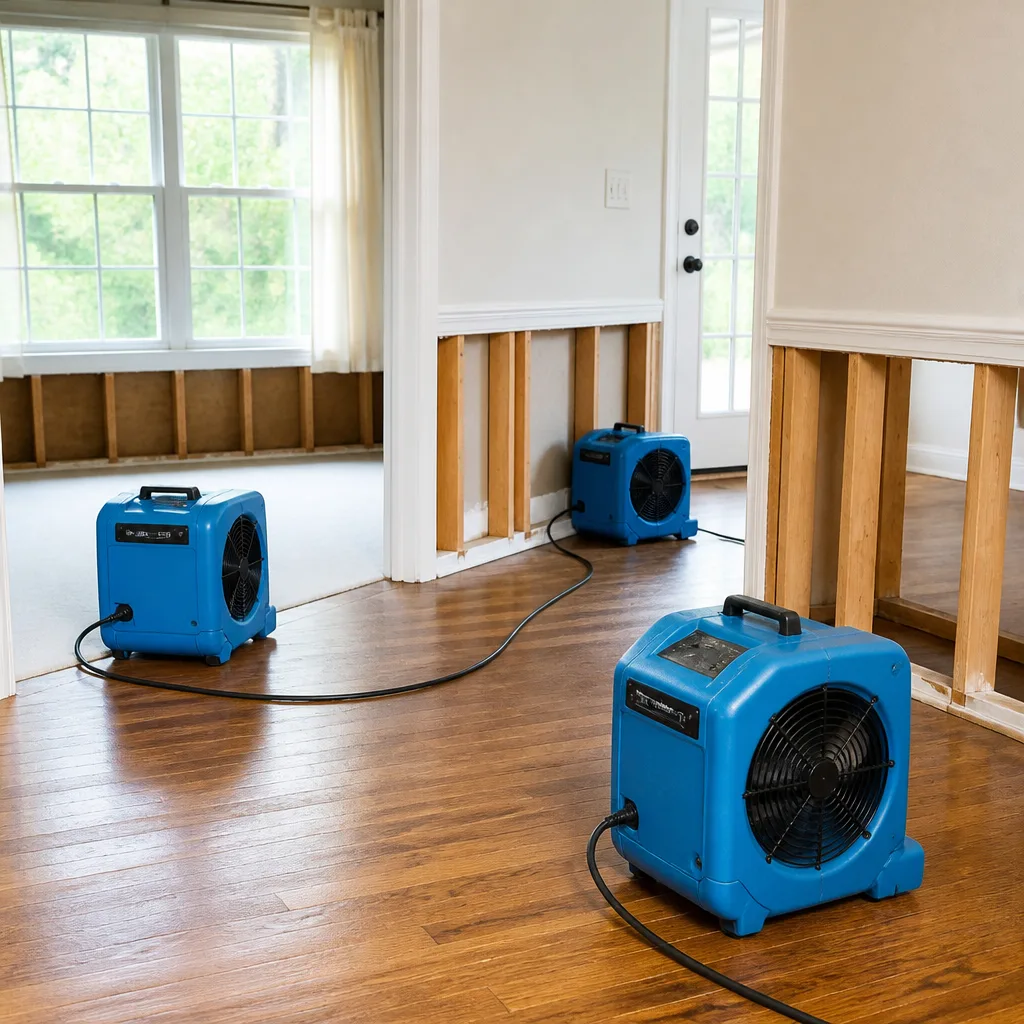
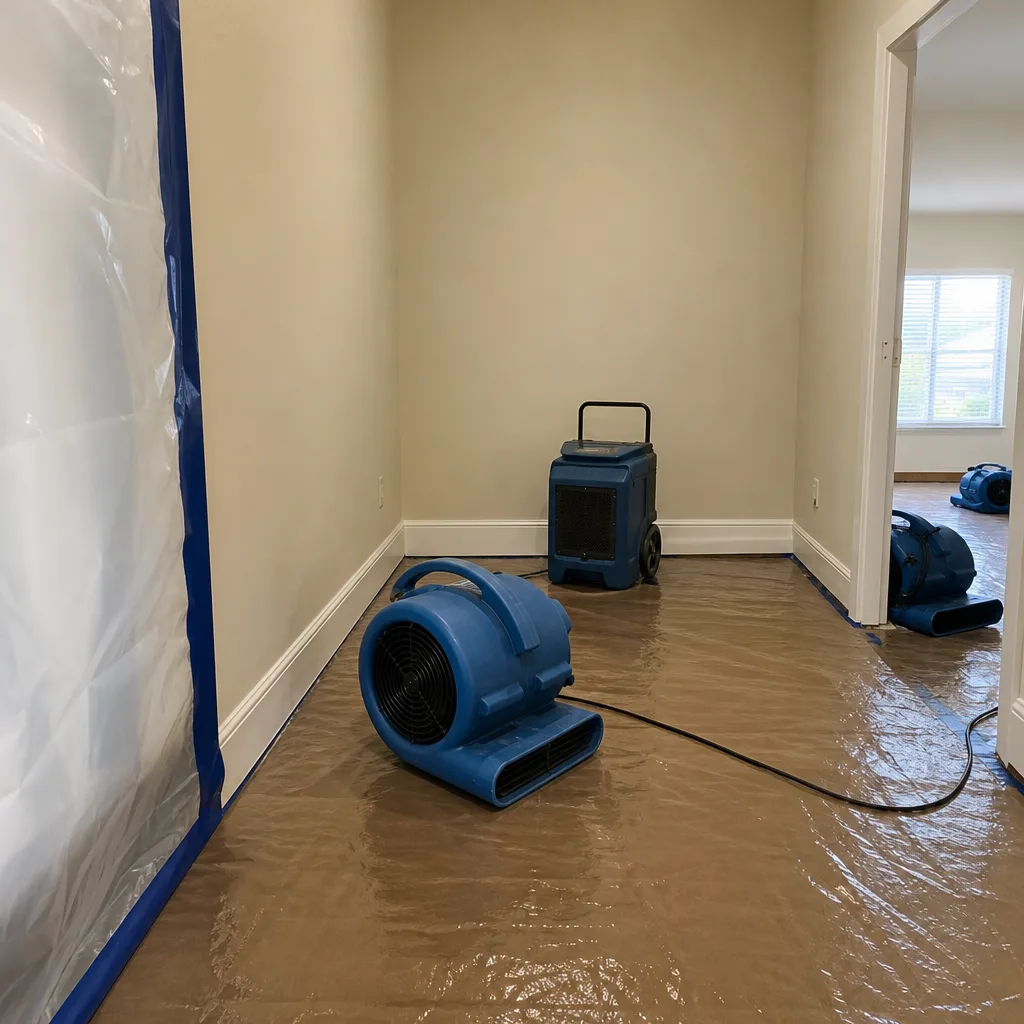
Dri-Eaz, for example, builds dehumidifiers and air movers specifically for structural drying. Their LGR dehumidifiers remove water from the air at above 80 percent relative humidity conditions, which is what you’re dealing with in a water-damaged home, not at 50 percent where consumer units operate efficiently. Phoenix builds compressors engineered for continuous industrial operation. B-Air produces high-velocity air movers designed to evaporate moisture from surfaces at a calculated rate, not to blow air around. Injectidry makes panel systems that pull air through wall cavities, under flooring, and through hidden structural spaces, drying areas that standard equipment cannot reach. These are the same brands used by large national restoration firms and institutional facilities. Their prevalence on a local company’s trucks tells you the operator has invested in the same structural drying standards.
When we walk into a Corona home affected by water damage, our first deployment is not a single dehumidifier in the affected room. It’s a calculated system: a Dri-Eaz LGR dehumidifier sized to the cubic footage, multiple B-Air air movers positioned to create airflow across every affected surface, and Injectidry panels where moisture has traveled into walls or under cabinets. This is structural drying, not surface drying, and the brand names matter because the performance curves of these machines are what the drying calculation depends on. Consumer-grade equipment does not have published capacity curves, so any drying calculation using them is essentially a guess.
The equipment audit from earlier in this guide becomes simpler when you understand the brand landscape. When a company names specific commercial lines, you can verify their claims. When they describe their equipment only as “professional grade,” without names or quantities, you’re dealing with a company that hasn’t made the same level of investment.
Protocol-Driven Process: What Documented Restoration Looks Like
Restoration is not a service where you can skip documentation and trust the outcome. Water damage left unseen creates mold. Mold left hidden creates health complaints and structural damage. Fire smoke leaves residues that can reactivate when humidity rises months later. A protocol-driven restoration company documents every step, because the insurer needs that documentation and the homeowner deserves it.
Here’s what a documented, protocol-driven water damage restoration in Corona looks like:
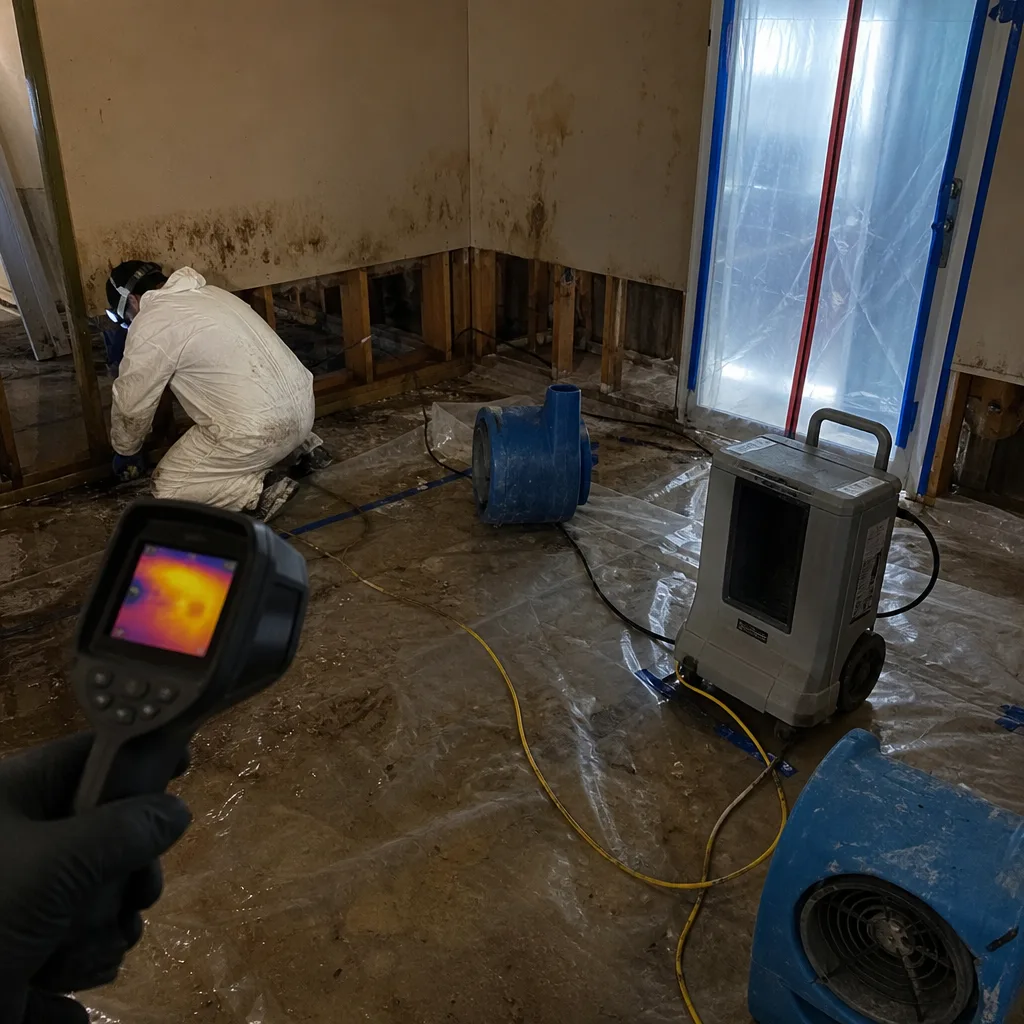
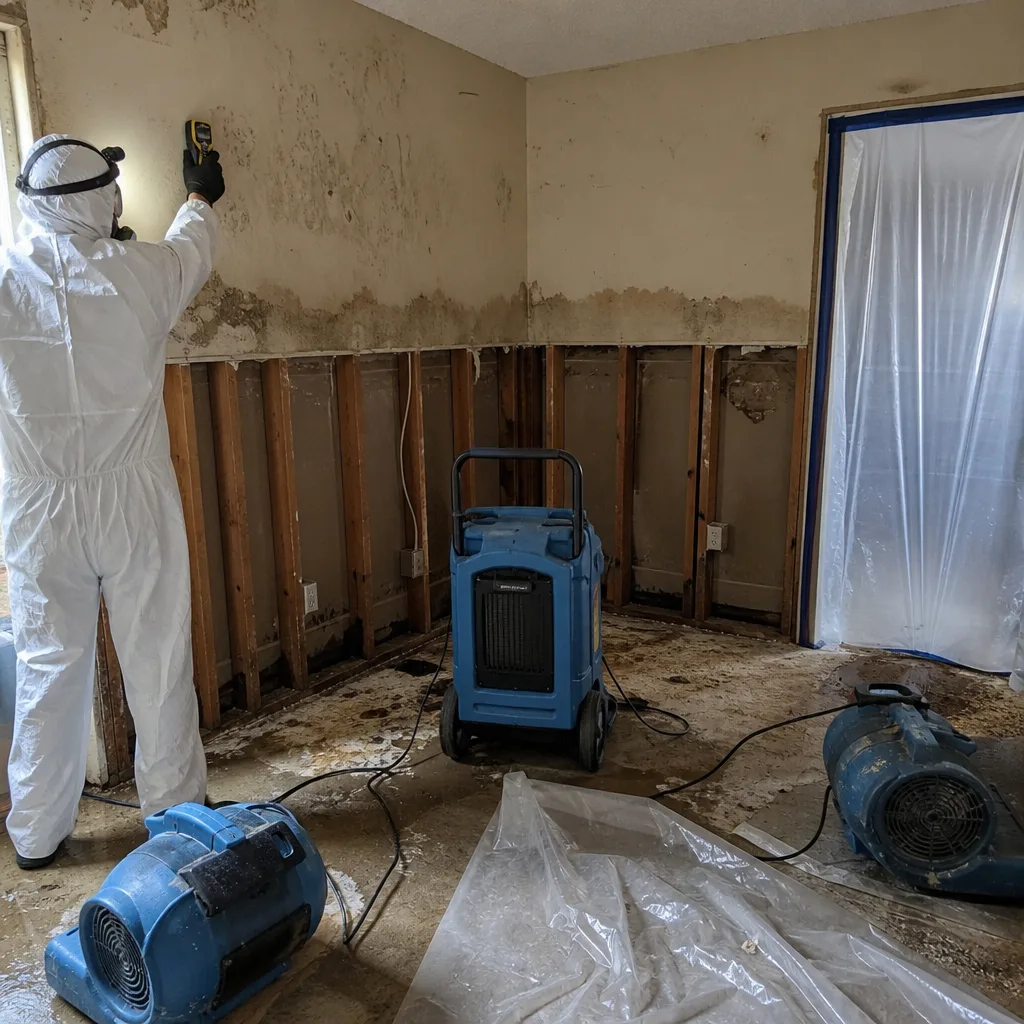
- Initial assessment and moisture mapping: The technician uses moisture meters and thermal imaging to locate all affected areas, including hidden moisture in walls, under flooring, and in structural cavities. Nothing is assumed.
- Water extraction: Truck-mounted or powerful portable extraction units remove standing water, followed by the calculated deployment of dehumidifiers and air movers.
- Dry load calculation: Using psychrometrics, the technician determines the total liters of water to be removed and confirms the equipment array has the capacity to do it.
- Daily monitoring: Moisture readings are taken at the same points daily, recorded on a dry log, and compared against drying curves to track progress.
- Final moisture verification: Before equipment is removed, readings confirm the affected materials are within safe moisture content ranges. This is not a visual check.
- Documentation package: The complete record, including initial photos, moisture maps, equipment placement, daily readings, and final readings, is provided to the homeowner and their insurer.
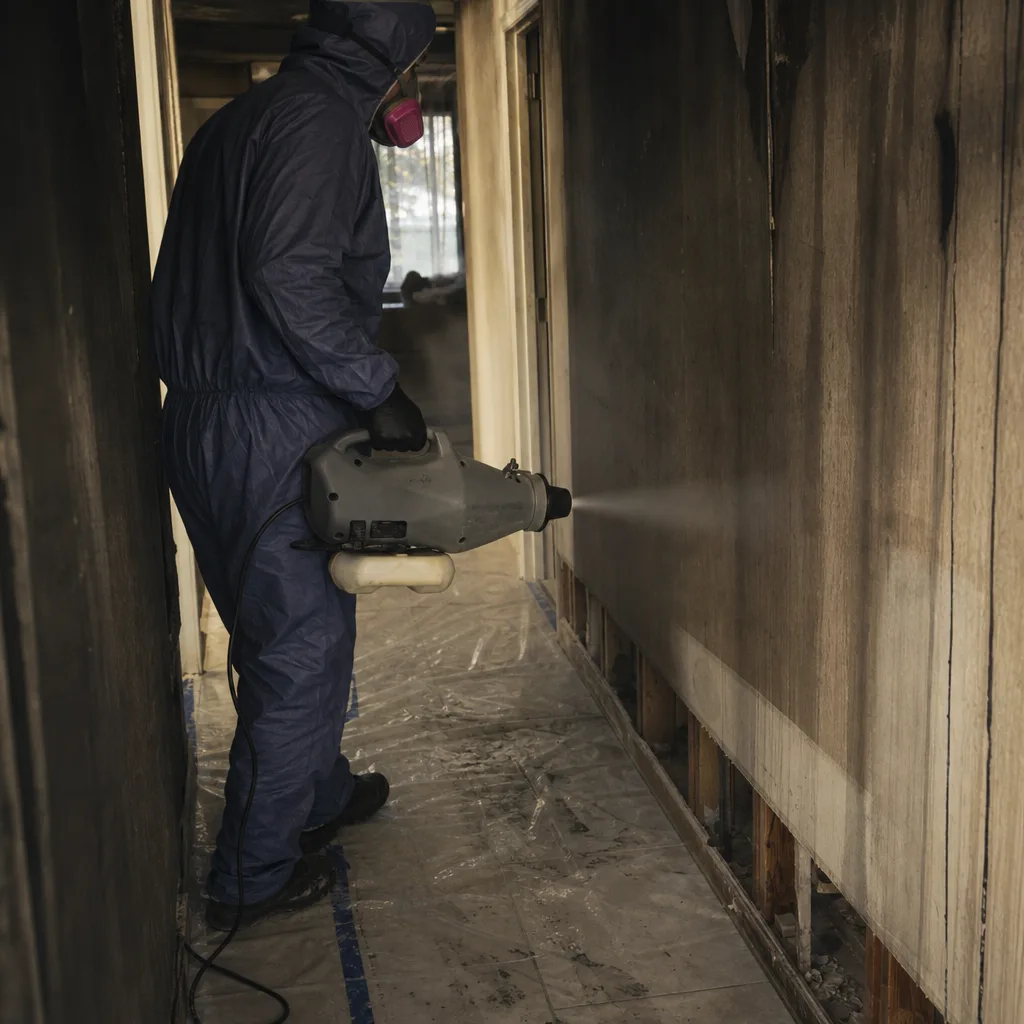
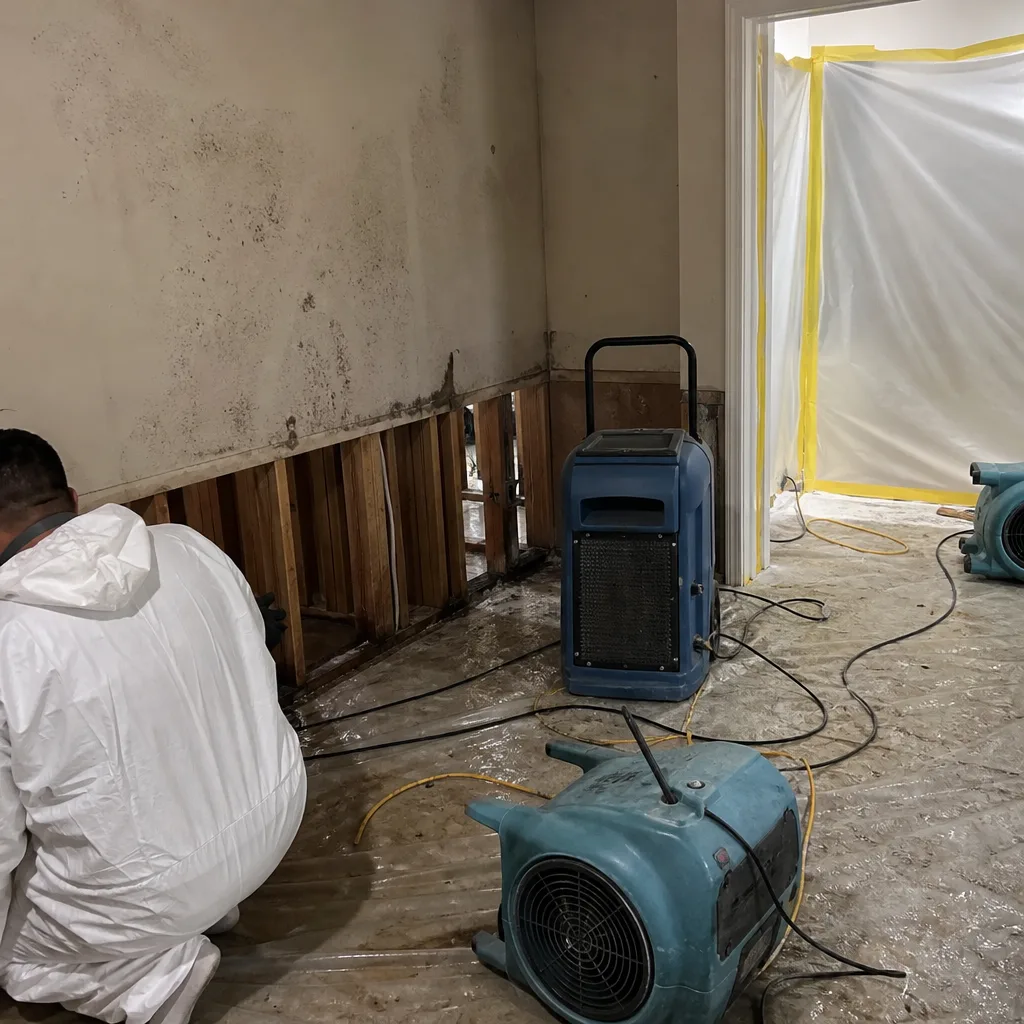
For mold remediation in Corona, the protocol includes containment of the affected area with negative air pressure, HEPA-filtered air scrubbing, removal of contaminated materials under controlled conditions, treatment of remaining surfaces, and post-remediation verification. Without the containment step, mold spores spread to unaffected areas of the home. Without the verification step, you cannot confirm the remediation actually cleared the problem.
Fire damage restoration requires its own protocols for soot removal, surface cleaning, and odor neutralization. Soot behaves differently depending on the materials burned. Natural materials produce easy-to-clean residues. Synthetic materials produce oily residues that smear if wiped improperly and release odor when heated. A protocol-driven restoration technician identifies the type of residue before selecting cleaning methods.
- Mold Remediation in Fallbrook demonstrates how these protocols apply across different property types and situations.
Common Mistakes to Avoid
- Choosing a company solely because it’s on your insurer’s preferred list. Preferred-vendor status means the insurer can process the claim efficiently, but it does not automatically mean the restoration company is the best fit for your property’s specific needs. Verify their certifications and equipment regardless of their insurer relationships.
- Not verifying IICRC certifications. The IICRC public registry takes minutes to check. If the names and designations on a company’s website don’t appear there, you have your answer.
- Signing a work authorization before reading it. Some restoration contracts include provisions that assign your insurance benefits directly to the contractor. Read every document carefully and understand what you’re authorizing.
- Focusing on price for emergency mitigation work. Emergency water extraction and drying require immediate, correct action. Shopping for the lowest bid while water spreads through your Corona home is a false economy. Your long-term costs are driven by how well the mitigation is done, not by the initial invoice.
- Accepting equipment rental costs without knowing the equipment is rented. If a company passes through rental fees for equipment they don’t own, you’re covering their operating deficiency. Ask the equipment question before you sign.
- Not getting an independent scope of work. When the restoration company and the insurer disagree, you need your own documentation. Request a written scope of work from the restoration company and share it with your adjuster yourself.
- Assuming mold isn’t present just because you can’t see it. Water that penetrates walls, flooring edges, or cabinets creates hidden reservoirs for mold growth. In Corona’s warm climate, mold can begin developing within 48 to 72 hours. If water damage wasn’t properly dried by a certified team, hidden mold is a real possibility.
When to Call a Professional
You should involve a professional restoration company any time water has penetrated beyond the surface of flooring or drywall, when visible mold growth covers an area larger than about ten square feet, or when fire damage has deposited soot beyond a single room. Attempting to dry hidden moisture without commercial equipment and moisture monitoring often leaves moisture behind, which becomes mold. Attempting to clean mold without containment spreads it. Attempting to clean fire residue without understanding soot chemistry can permanently set odors and stains.
If you’re in Corona and dealing with active water intrusion, visible mold, or fire damage of any kind, OC Restoration Co offers free estimates. Call (833) 589-7005 and we’ll assess the scope, explain the protocol, and give you a written plan before any work begins.
Frequently Asked Questions
Visit the IICRC’s public certification registry online, enter the company name or the individual technician’s name, and confirm the certification is current and matches the claimed designations. IICRC certifications must be renewed through continuing education credits, so check the status is active, not expired. Any company that refuses to provide certification numbers for the technicians who will perform your work should be removed from consideration.
A franchise location operates under a national brand’s license and must follow corporate procedures, but is independently owned and operates its own equipment and staff. An independent restoration company operates under its own name with direct local accountability. Quality varies more within franchises than most homeowners expect, so evaluate the local operation’s certifications and equipment rather than the national logo.
Ask directly whether they own their dehumidifiers and air movers, and ask for specific brand names. Companies that own commercial lines like Dri-Eaz, Phoenix, Injectidry, or B-Air have made capital investments that rental-based operators have not. Owning equipment means faster deployment and more experienced operators, both of which benefit your Corona home when every hour matters.
Standard homeowner policies typically cover sudden and accidental water damage, such as a burst pipe, but not gradual leaks or flood damage from rising groundwater. Mold remediation coverage varies by policy and is often capped at a specific dollar amount. We recommend calling your agent immediately after a water event, then calling us at (833) 589-7005 for a documented scope of work that supports your claim. For detailed pricing information, see our Damage Restoration Cost Breakdown: The Corona Homeowner’s Reference for 2026.
A restoration company should respond immediately, with crews on site within hours, not days. Water spreads through drywall, flooring, and structural cavities with every hour that passes. In Corona’s warm climate, the window for preventing mold growth is short. Ask the company where their crews are located and whether they can reach your property immediately.
Look for FSRT (Fire and Smoke Restoration Technician) certification, experience with smoke odor removal, and a documented scope of work covering both structural cleaning and content restoration. Fire residue requires specialized chemistry knowledge to remove properly; a general cleaning crew without restoration training can set stains and odors permanently. Call (833) 589-7005 for a free assessment of your fire damage in Corona.
The Bottom Line
The brand on the truck matters less than the certifications in the technician’s wallet, the equipment on the truck, and the documented process the company follows. In Corona, where water damage, mold, and fire events hit local homes every week, the right restoration partner is one who can prove their IICRC credentials, show you their commercial drying equipment, and provide local references. Before you need them, take thirty minutes to vet a restoration company the way this guide describes. When the emergency comes, you’ll be choosing from knowledge, not anxiety. If you’d like to see what protocol-driven restoration looks like in practice, call (833) 589-7005.
Written by the team at OC Restoration Co, serving Corona since 2017.
See the difference
 Before
 After
 Before
 After
 Before
 After